
NSW Plumbing Licence 456767C
Sewer Pump Services operates under a current NSW plumbing contractor licence — licensed plumbing and drainage work, on record.
Custom fibreglass pump pits engineered for the pump that goes in them — installed, fitted with the pump, wired, and tested before we leave. For new homes and failed-pit replacements across Sydney. Trading since 1985.
A pump pit is a sealed chamber set into the ground that collects wastewater or stormwater that can't gravity-drain to the main. Inside sits a submersible pump that lifts the water up to the point where it can flow away on its own. The pit and the pump work as one system.
You need one when the property sits below the level of the main — waterfront blocks, sloping sites, basements, and granny flats or lower rooms built below the street. If the water can't run downhill to the main by gravity, it has to be pumped, and that means a pit and a pump sized to the job.
In practice, most pit installations are sewer pits — for homes that can't gravity-drain to the main. Stormwater pits on bigger developments are usually formed by civil works as part of the building structure, so there we fit the pump system rather than the pit itself. Either way, the pit is where it all starts — get it wrong and everything that goes in it inherits the problem.
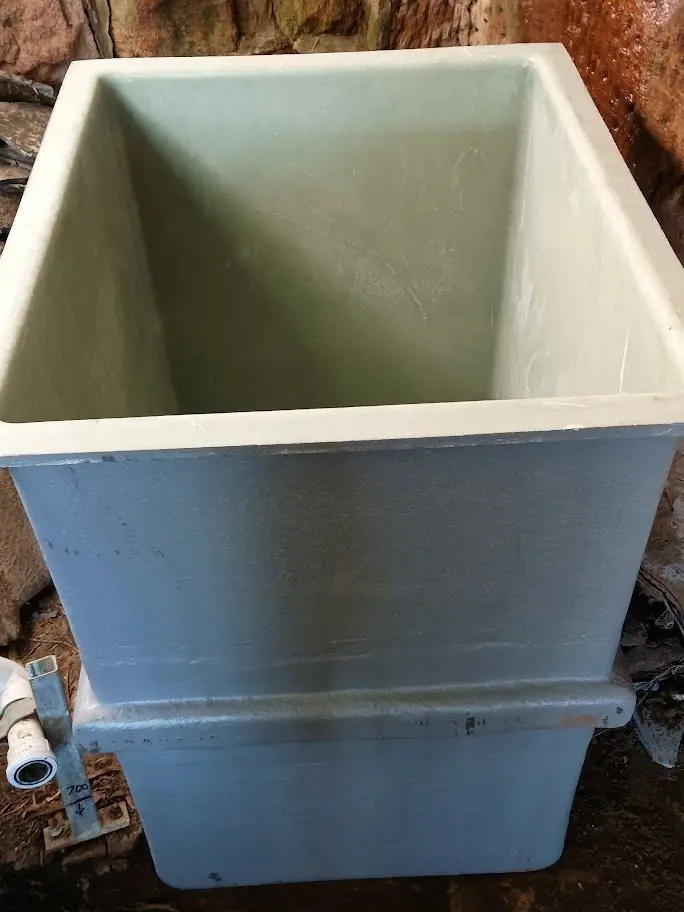
Most pit failures come back to the pit itself — a thin generic tank that cracks or distorts in the ground. Ours are built so that doesn't happen.
External ribbing runs around the outside of the tank to support the frame, and the wall thickness is built for the load the pit will carry in the ground. It holds its shape under pressure instead of flexing and splitting the way a thin moulded tank does.
The pit is made for the pump that goes in it — sized for the duty, the float travel, and the pipework — rather than a generic chamber you drop any pump into and hope it fits. Pit and pump as one system, not two parts bolted together.
The pit is sealed against ingress, then concreted in at the base — not just backfilled. A lightweight fibreglass pit will try to float when the ground saturates in heavy rain: hydrostatic pressure pushes up underneath and can lift an empty pit out of the ground. Concreting the base in anchors it down so it stays put. The groundwork matters as much as the pit.
Fibreglass pits engineered this way are our standard for sewer pump installations — and the reason a properly installed pit lasts a lifetime while the pump inside it simply gets serviced or swapped over its service life.
A recent waterfront job, step by step — an old sewer pump and failed pit replaced with a new custom fibreglass system, with everything brought in by barge. A new-build install runs the same, minus the demolition at the start.
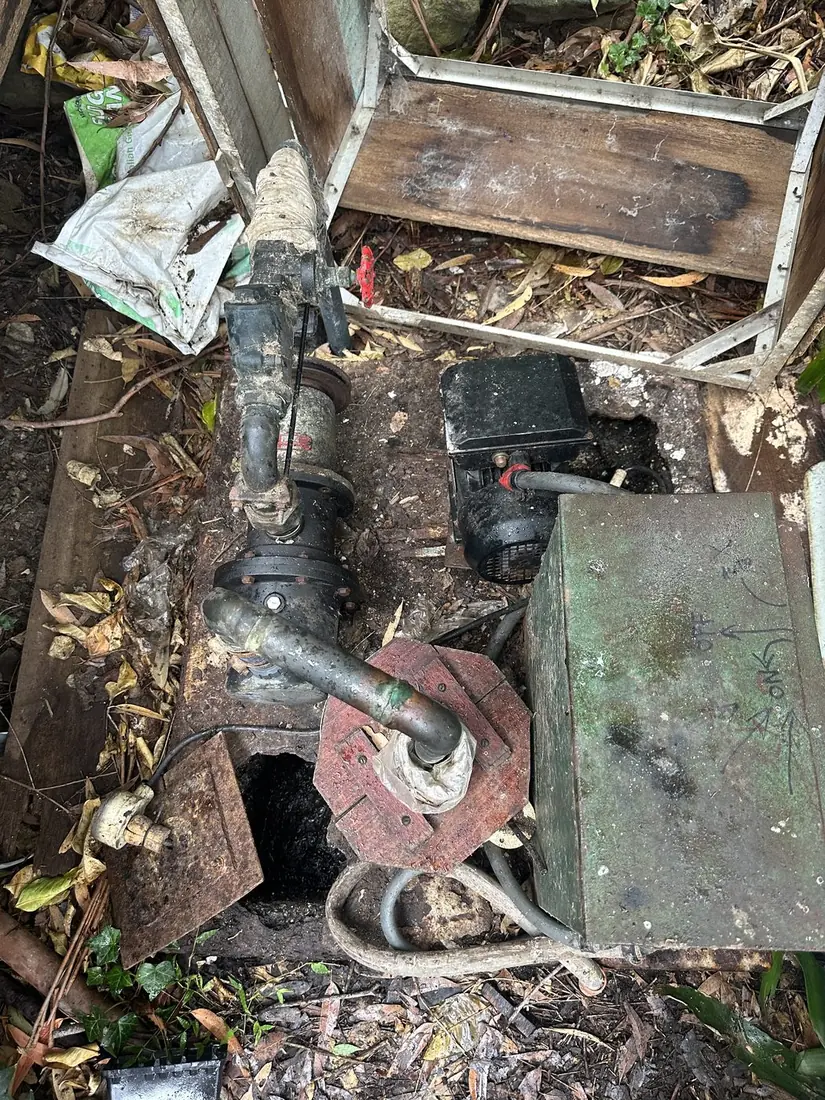
Where this job started — an old sewer pump, corroded pipework and a hand-labelled control box, all well past their service life.
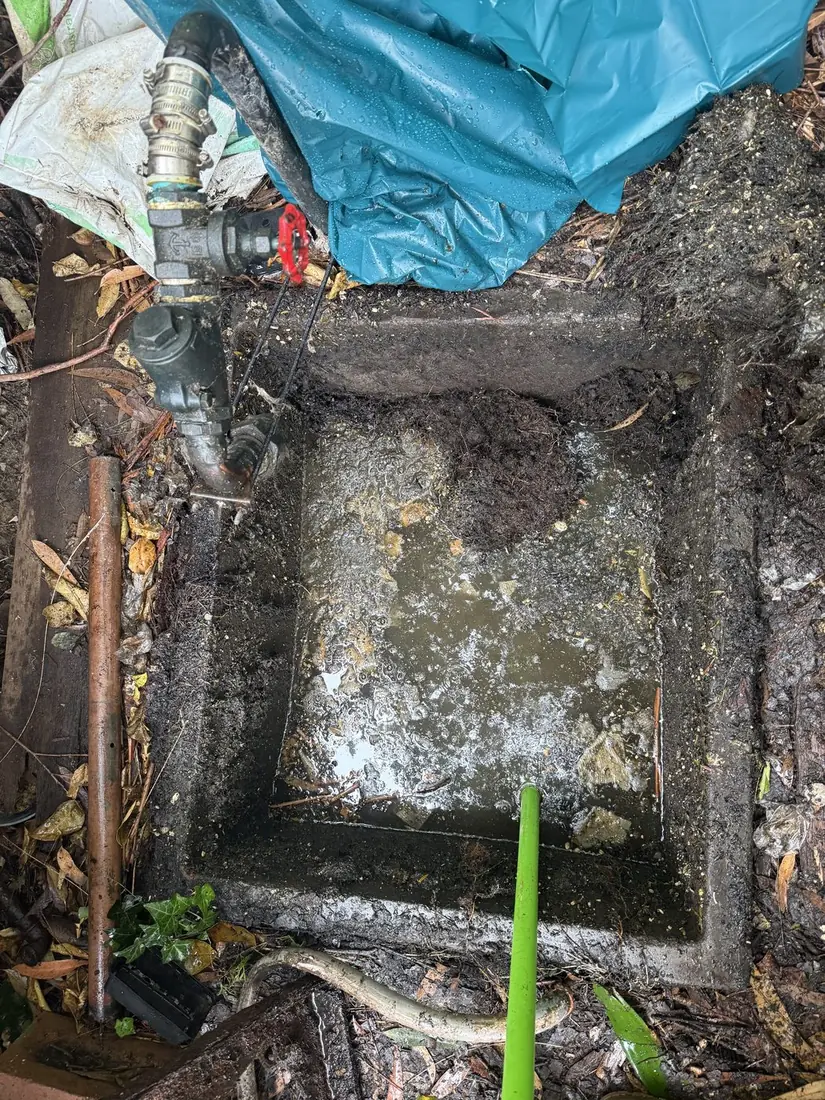
Lid off the old concrete pit — tree roots had grown straight in through the walls. Here it's part-way through being cleaned out before the old chamber comes out.
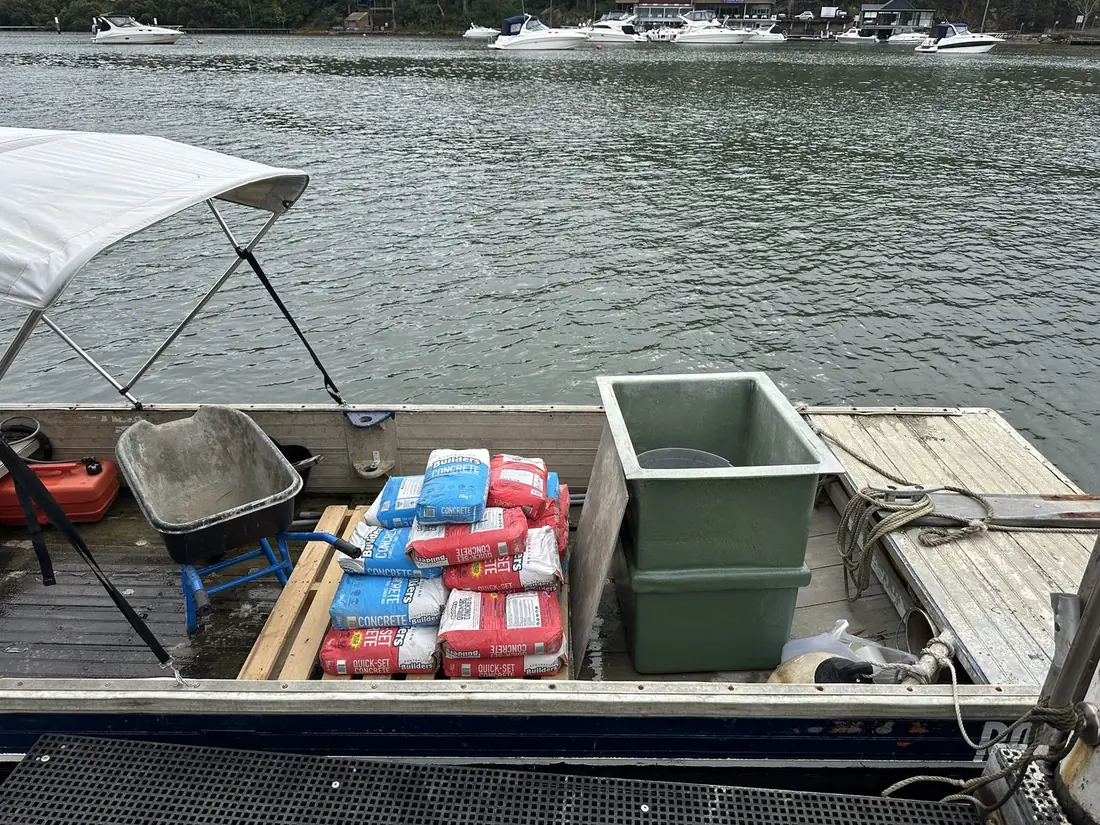
Waterfront access means everything comes in by water — the new fibreglass pit, the concrete, the lot, brought across to a site no truck can reach.
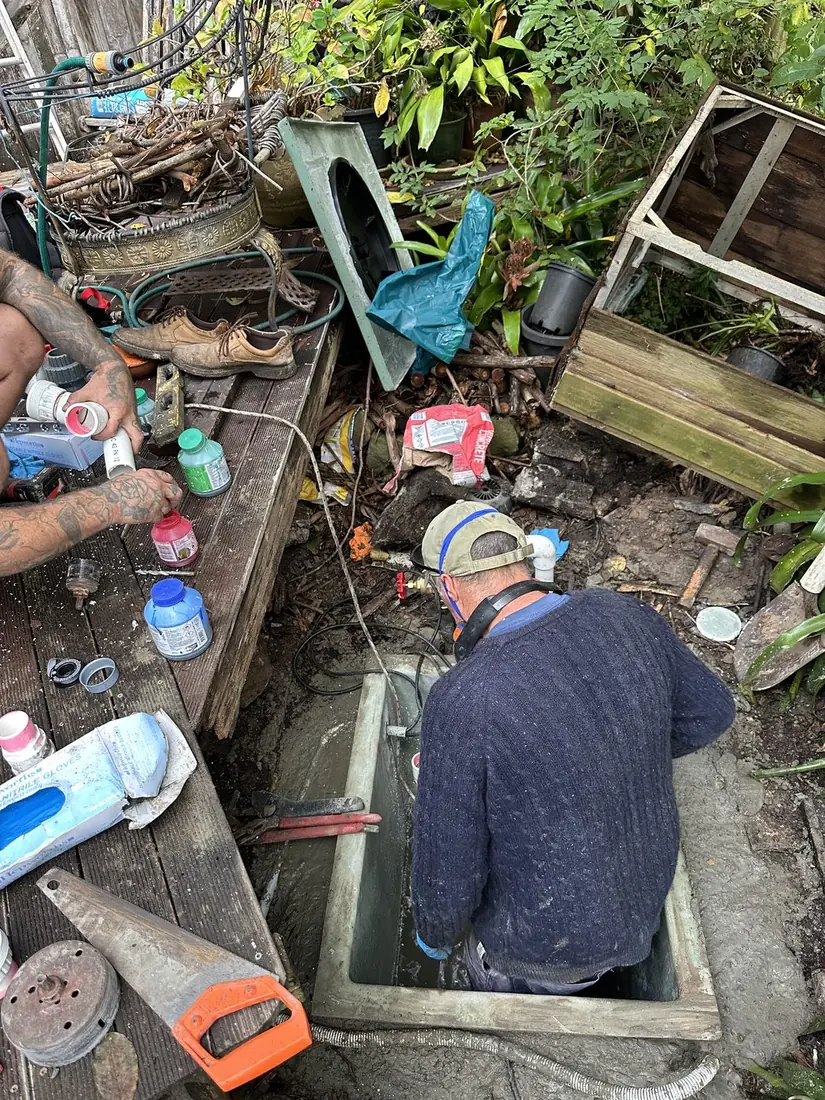
On the tools — Stuart down in the new pit, pipework cut and primed up top. The new fibreglass chamber set and connected.
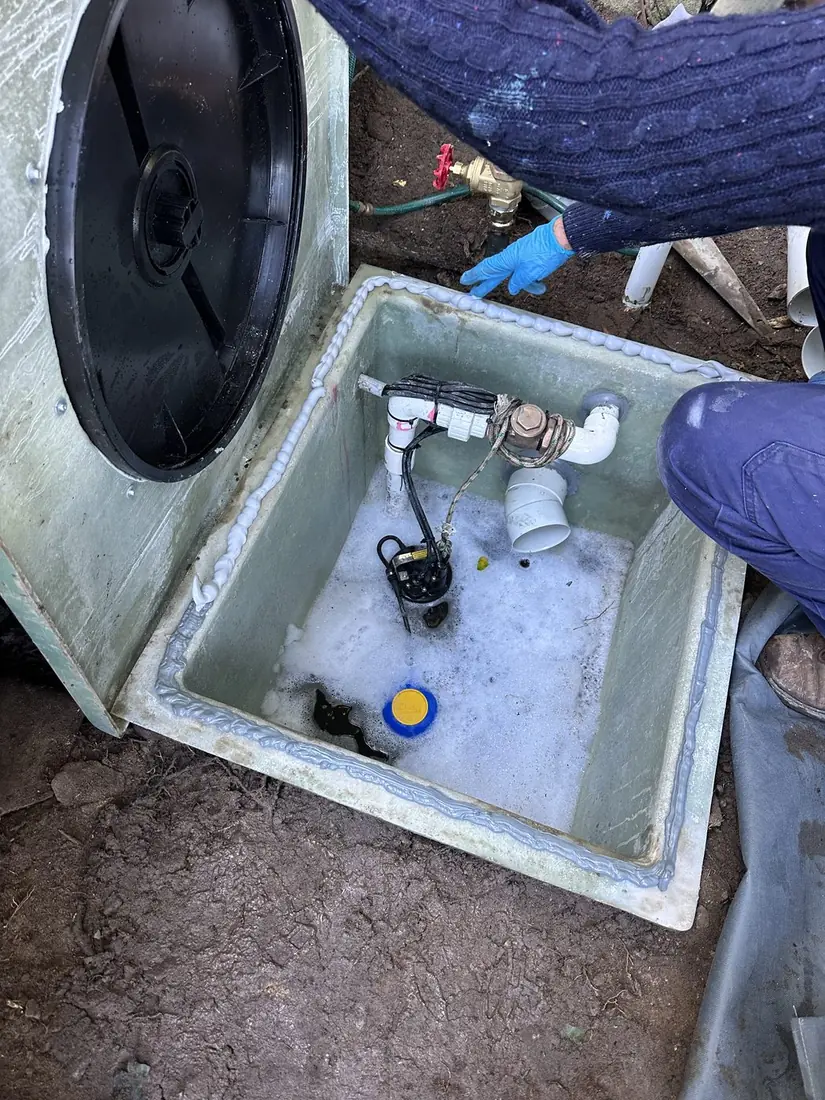
The new custom fibreglass pit in and sealed — Sikaflex bead around the lid seat, new submersible pump and float fitted, pipework connected.
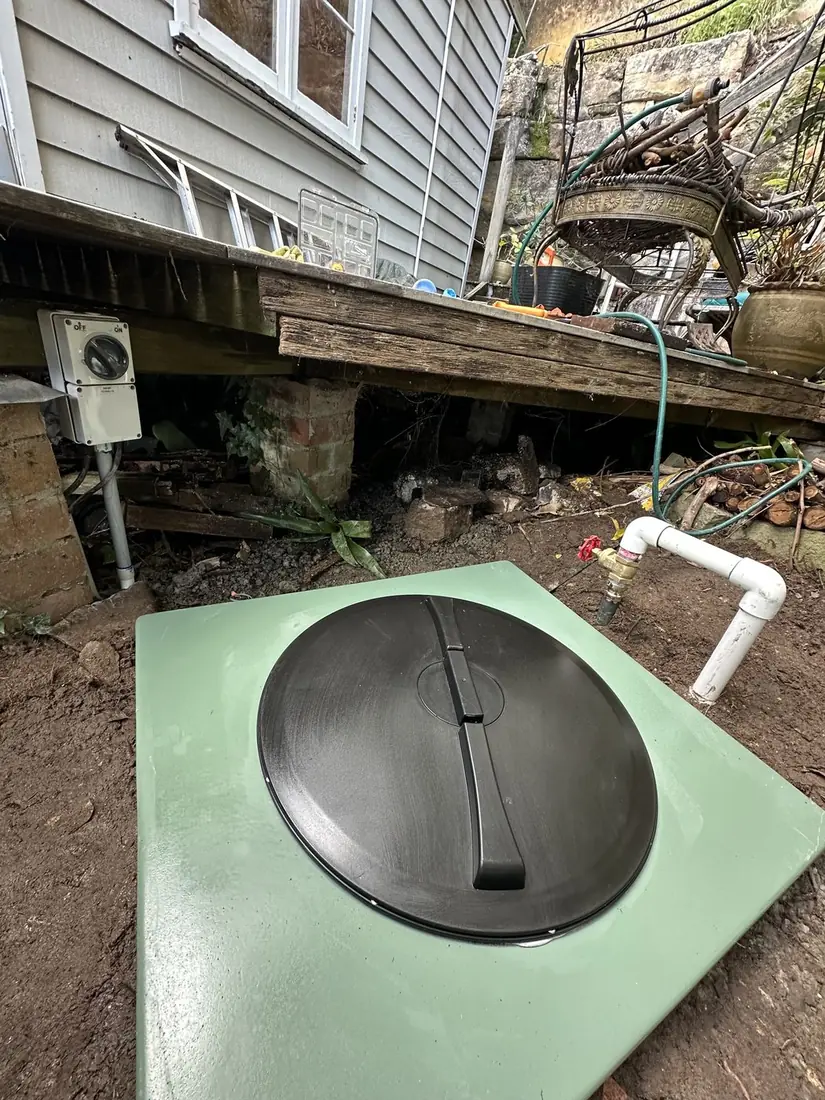
The finished job — pit capped, isolator mounted and wired, pipework run neat. Tested through a full cycle and commissioned before we left.
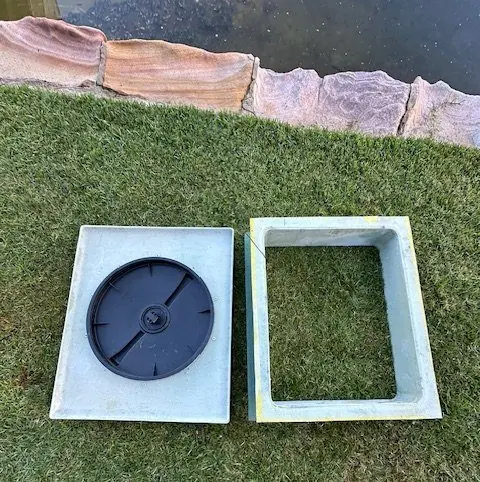
Sometimes the inlet line coming from the house sits well below ground level — on a steep block, or where the drainage runs deep before it reaches the pit. The pit has to be set down to meet it, which can leave the chamber a long way below the surface.
That's where a riser comes in: an extension that sits on top of the pit and brings the lid and access up to ground level. It means the pump can still be reached and serviced from the surface, without digging anything up. We size the riser to the depth so the finished lid sits flush and the pump stays accessible for the life of the system.
The pit is half the system — the pump is the other half, and the two are matched. We set the submersible pump, configure the float switches, wire the control panel, and fit the overload protection as part of every install. Davey D-series submersibles are our default; where the head or duty calls for a bigger pump we step up to DAB, Bianco, or Liberty.
There's a lot more to pump selection — duty curves, head, foreign-object handling, redundancy — than belongs on a pit page. If you want the detail on which pump suits which job, it's all on our sewer pump installation page. For the pit itself, the short version is simple: we size the pump to the job and fit one we can stand behind.
Pit work is licensed work, often deep work, and always work that has to meet the standards Sydney is built to.
Sewer Pump Services operates under a current NSW plumbing contractor licence — licensed plumbing and drainage work, on record.
Plumbing and drainage work is carried out to the AS/NZS 3500 standard family — the benchmark for compliant work across Sydney.
Issued by NSW Fair Trading under the disconnect/reconnect framework (UEERL0004). We connect the pump and alarm, set up the control panel and fit the overload protection ourselves; your electrician runs the supply.
Statement of Attainment from Pinnacle Safety and Training (RTO 40496). Deep pits and confined spaces are part of the trade — most residential pits never need it, but when one does, we're set up for it.
Public liability and workers compensation cover in place across all work, with certificates of currency available on request.
A plumbing trade since 1985, pumps-only since 2010. You deal with the same operators from first call through to commissioning.
Based in the Sutherland Shire. Installing pump pits across greater Sydney.
Cronulla · Caringbah · Sutherland · Miranda · Bundeena · Burraneer · Lilli Pilli · Yowie Bay · Sylvania Waters · Como · Woolooware · Illawong · Kangaroo Point
Manly · Mosman · Dee Why · Brookvale · Freshwater · Curl Curl · Collaroy · Whale Beach · Palm Beach
Cammeray · Longueville · Hunters Hill · Lane Cove · Northbridge · Chatswood
Bondi · Randwick · Coogee · Maroubra · Vaucluse
Newtown · Marrickville · Leichhardt · Ashfield
Not listed? Call us — we cover all of metropolitan Sydney for pump pit installation.
The questions people ask before putting a pit in the ground.
A pump pit is a sealed chamber set into the ground that collects wastewater (or stormwater) that can't gravity-drain to the main, with a submersible pump that lifts it up to where it can flow away. You need one when the property sits below the level of the sewer or stormwater main — common on waterfront blocks, sloping sites, basements, and granny flats or lower-level rooms built below the street. If water can't run downhill to the main on its own, it has to be pumped, and that means a pit and a pump.
Our pits are custom-made fibreglass with external ribbing that supports the frame and a wall thickness built for the load they'll carry — so they don't crack or distort in the ground the way a thin generic tank can. The pit is also engineered for the pump that goes in it, rather than a tank you drop any pump into and hope it fits. That's the difference between a pit that lasts a lifetime and one that fails inside a few years and has to be dug up and replaced.
Both, as one job. We install the fibreglass pit, set the submersible pump and float switches inside it, run the pipework, set up the control panel and overload protection, and commission the system before we leave. The pit and pump are designed to work together — installing them as one job is how you get a system that runs properly rather than two parts that don't quite match.
Yes — it's a big part of what we do. A cracked or collapsed pit gets dug out, the hole prepared and squared up, and a new custom fibreglass pit set in its place, then the pump and electrical reinstated. The install runs the same as a new one, just with the old pit removed first. If your existing pit is failing, the sooner it's looked at the less mess it makes.
It depends on the site — how far below the main the property sits, and where the inlet pipework arrives. Some pits sit a metre or so down; others go considerably deeper. We assess the fall and the inlet level before we quote so the pit's sized and set at the right depth, with the pump positioned so the floats switch at the right levels. A pit that's set too shallow or too deep causes problems later, so it's worth getting right at the start.
The pump-side electrical is ours. We connect the pump and alarm, set up the control panel, and fit the overload protection — the part that trips the pump before the motor burns out if something jams it — all under our Restricted Electrical Licence (UEERL0004). Where there's a separate power supply to run to the pit, your electrician handles that and we connect to it.
Davey D-series submersibles are our default — reliable, well-supported, parts available across Sydney. Where the head or duty calls for a bigger pump we step up to DAB, Bianco, or Liberty, and Liberty's our pick for homes with young kids since it handles foreign objects better. There's more on pump selection on our sewer pump installation page — for a pit install, the short version is we size the pump to the job rather than fitting whatever's cheapest.
A straightforward install is typically a day or two on site once the hole's dug, depending on access, depth, and whether it's a new install or a replacement that needs the old pit out first. We'll give you a clear timeframe with the quote. We'd rather book it properly than rush a pit into the ground and have it cause problems down the track.
Send your name, number and what's going on — we'll get back to you the same business day. For active flooding or sewage backup, please call instead.
Urgent? Call 0415 210 267 — 24/7.
Custom fibreglass pits engineered not to crack, fitted with the pump, wired and tested before we leave. Sewer and stormwater pumps are our specialty — and the pit is where it starts.