
NSW Plumbing Licence 456767C
Sewer Pump Services operates under a current NSW plumbing contractor licence — licensed plumbing and drainage work, on record.
Sewer and stormwater pump work for strata buildings and managed properties across Sydney. Most of our strata work is stormwater — basement carpark pits, dual pump systems, and alarm panels — across complexes and apartment buildings of every size. Trading since 1985, specialist pump focus since 2010.
Strata managers spend a lot of time managing the trades they coordinate. Plumbers who don't return calls, contractors who quote vague, technicians who rotate through buildings without knowing the history. Pump work specifically tends to get punted to whichever general plumber is available — which usually means the work gets done badly, the alarm panel doesn't get tested properly, and the same pit is back on a callout six months later.
We're not general plumbers. Sewer and stormwater pumps are the focus of the business. The depth of pump-specific experience matters because most strata work is the harder, higher-consequence end of the trade — basement carparks where a stormwater pump failure floods a row of vehicles, dual pump systems where alarm panel logic has to be read correctly, multi-unit sewer ejectors that fail under continuous load if they're sized wrong.
The relationship that works for strata managers is the one that keeps the same specialist on the building's pump record across years and decades. Same contact, same direct line, written reports formatted for the committee, certificates of currency on file, after-hours emergency response when the alarm fires at 2am. That's what we offer, and it's also what most general plumbers can't.
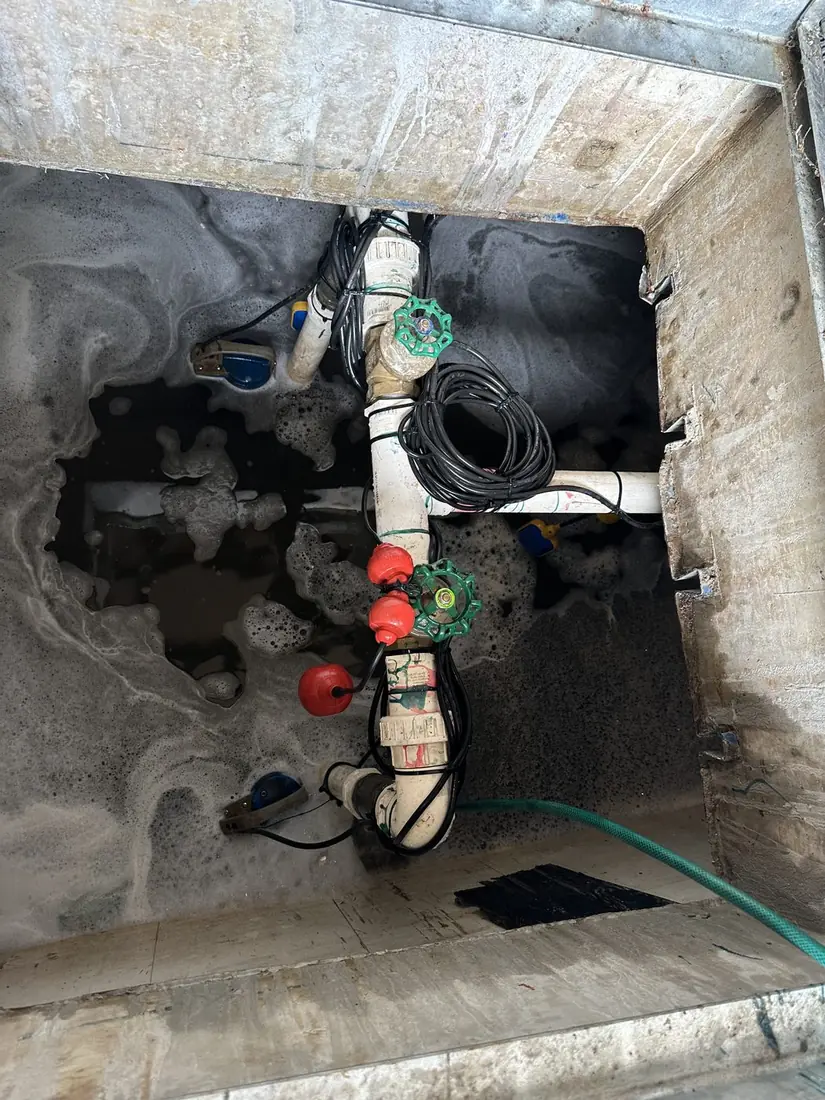
Most strata pump work is stormwater. If your building has a below-ground carpark, the stormwater pit and pump system is what stops vehicle damage in heavy rain.
The typical Sydney strata stormwater system is a fibreglass or concrete pit in the lowest point of the basement carpark, fed by surface drainage from ramps, gutters, and any below-ground floor area that can't gravity-drain to the street. The pit collects inflow; the pump (or pumps) lift it up to a discharge point that connects to the council stormwater main or a legal point of discharge.
For any pit where overflow has nowhere safe to go, the standard is a dual pump setup. Basement carparks are the obvious case — a failed primary pump means standing water across the floor and damage to every vehicle parked on it. Backyard sewer pits where overflow tracks down the lawn and onto the neighbour's property are another. Below-grade plant rooms with no drainage path out, the same problem.
The setup is two pumps that alternate runs, controlled by an alarm panel managing the cycle. Alternating means each pump takes turns being the lead — neither sits idle for years and seizes, and wear is shared evenly across both. The alarm panel signals when both pumps have had to run together (inflow exceeded what one pump can clear) or when an expected pump fails to start when called. Either way you find out before the next storm event rather than during it.
Where we earn our place on strata stormwater work:
Strata stormwater pits get sized to peak storm-season inflow rather than average rainfall. We assess the catchment, the surface area draining to the pit, and the worst-case storm event the system needs to handle without overflowing.
Two-pump alternating systems — each pump takes turns leading so wear is shared and neither sits idle. Failover testing on every service visit. Alarm panel testing so you know it'll fire when it needs to.
Panels from Kenrahn, Metalec, and the generic OEM panels supplied with imported pump units. We test alarm logic, replace failed indicators, and brief the building manager on what each alarm state actually means.
Stormwater pits accumulate leaves, grit, and debris over time. The real failure point isn't silt at float level — it's debris reaching the pump and blocking the impeller or strainer. Pull the pump, inspect and clear the impeller and strainer — part of every routine service visit.
Six-monthly servicing across most strata stormwater systems. Float testing, alarm panel verification, pit inspection, pump performance check. We schedule, remind, complete, and report — the building manager doesn't have to track due dates.
If a previous contractor installed an undersized pump, used the wrong pit type, ran discharge through the wrong materials, or left the alarm panel half-wired — we'll diagnose and rectify. Most of our new strata clients come to us this way.
Sewer pit work for strata buildings is less common than stormwater — most strata buildings sit above the sewer main and gravity-drain naturally. Where sewer pumps do exist on a strata property, it's usually because the building has bathroom, laundry, or kitchen facilities below the sewer main level: basement units, lower-ground-floor amenities blocks, below-grade caretaker apartments, gym or pool plant rooms with floor drains.
Strata sewer pump systems handle continuous load from multiple dwellings or fixtures rather than the intermittent load of a single house, which means the pump needs to be sized for total-units-occupied throughput, not nominal residential flow. Cutter or grinder pumps are common where solids handling matters; in older Sydney apartment buildings, we still find original sewer ejector setups that should have been replaced two pump-lifecycles ago.
The work splits into three categories — scheduled servicing (annual, sometimes six-monthly for high-load buildings), repair callouts for pump failures, intermittent floats, and alarm panel faults, and full replacement when an aging system has reached the end of service life. All three are areas where specialist setup beats general-plumber trial-and-error every time.
The operational layer matters as much as the technical work. Strata managers run on documentation, schedules, and approvals — we work within that framework, not against it.
Every job gets a service report covering what was found, what was done, test readings, and recommendations.
Six-monthly stormwater, annual sewer — adjusted to building age and history. We schedule, remind, complete, and report. The building manager doesn't have to chase any of it.
One direct line, one specialist on your building's pump record across years. One contractor on site — plumbing and electrical handled in-house, not three trades coordinating around each other. No call centre, no rotating technicians.
Active overflows and alarm-and-smell situations at strata buildings get priority routing. Realistic ETA given on the phone, not a vague "as soon as we can."
Public liability, professional indemnity, workers' compensation — current certificates available on request, emailed direct or uploaded to whatever contractor management platform your firm uses.
WHS Management Plan and Safe Work Method Statements (SWMS) available on request — the documentation managing agents need on file before work proceeds. Supplied ahead of a scheduled job or as part of contractor onboarding.
“We engaged Ayden to help with quite a tricky stormwater pump situation. Not only was he clear in his explanations, he was always courteous and very professional. The job took a few days and his team were very thorough and knew what they were doing. I can recommend Ayden and Sewer Pump Services highly and without hesitation.”
What this work actually looks like.
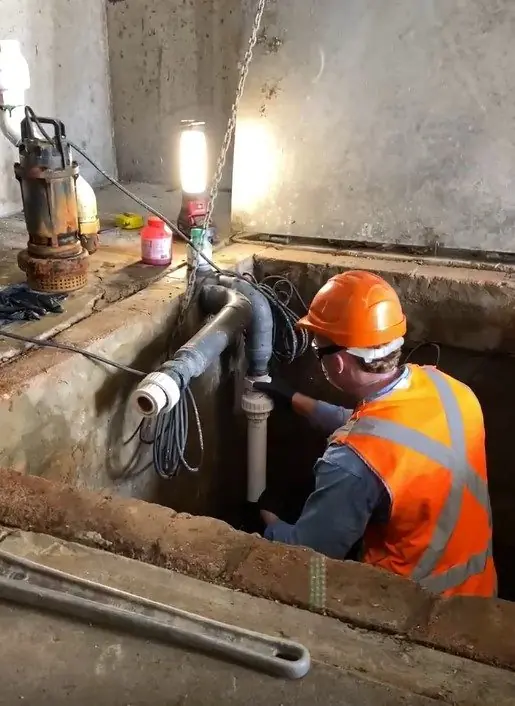
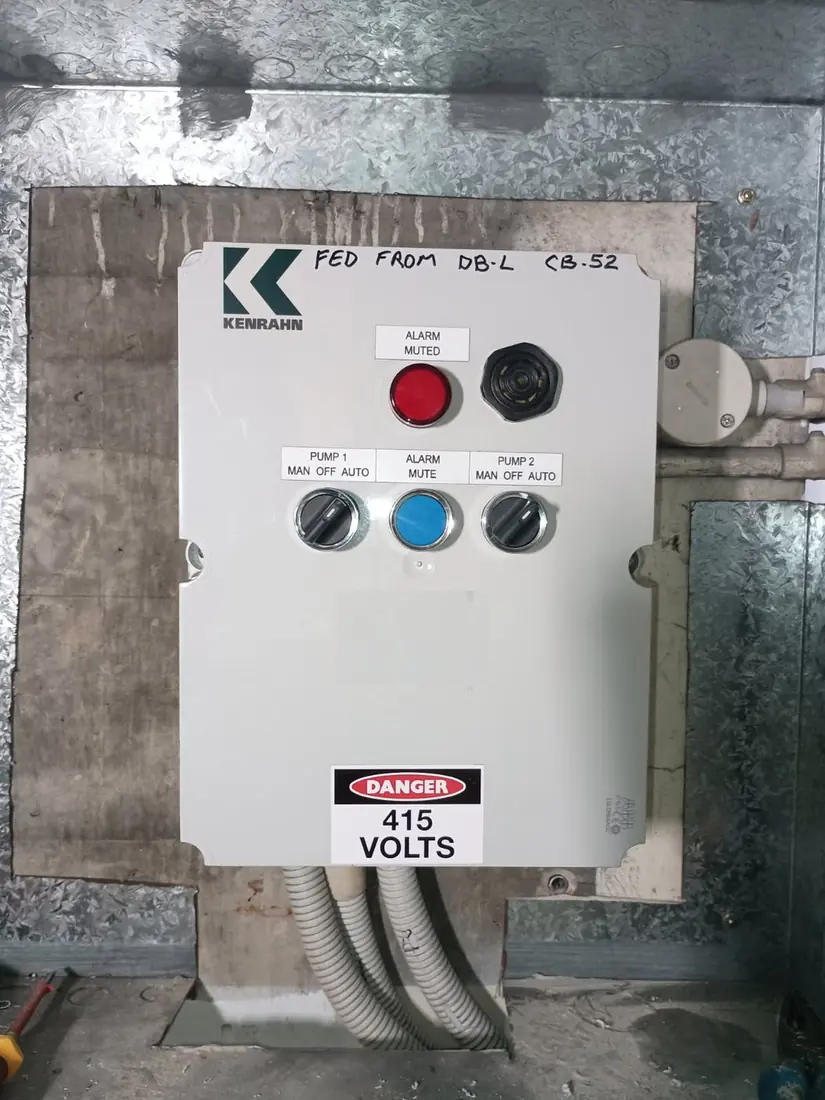
Same-day callouts for active overflows. After-hours priority routing for strata. Certificates of currency on request.
Specialist work means licensed work, documented work, and work that meets the standards Sydney is built to.
Sewer Pump Services operates under a current NSW plumbing contractor licence — licensed plumbing and drainage work, on record.
Plumbing and drainage work is carried out to the AS/NZS 3500 standard family — the benchmark for compliant work across Sydney.
Issued by NSW Fair Trading under the disconnect/reconnect framework (UEERL0004). We connect the pump and alarm, set up the control panel and fit the overload protection ourselves; your electrician runs the supply.
Statement of Attainment from Pinnacle Safety and Training (RTO 40496). Deep pits and confined spaces are part of the trade — most residential pits never need it, but when one does, we're set up for it.
Public liability and workers compensation cover in place across all work, with certificates of currency available on request.
A plumbing trade since 1985, pumps-only since 2010. You deal with the same operators from first call through to commissioning.
Based in the Sutherland Shire. Servicing strata buildings across greater Sydney.
Cronulla · Caringbah · Sutherland · Miranda · Bundeena · Burraneer · Lilli Pilli · Yowie Bay · Sylvania Waters · Como · Woolooware · Kangaroo Point
Manly · Mosman · Dee Why · Brookvale · Freshwater · Curl Curl · Collaroy · Whale Beach · Palm Beach
Cammeray · Longueville · Hunters Hill · Lane Cove · Northbridge · Chatswood
Bondi · Randwick · Coogee · Maroubra · Vaucluse
Newtown · Marrickville · Leichhardt · Ashfield
Not listed? Call us — we cover all of metropolitan Sydney for strata installation, replacement, servicing, and emergency work.
What strata managers ask before they put a new contractor on the building's record.
Yes. Public liability, professional indemnity, and workers' compensation certificates of currency are available on request — emailed directly to your office or uploaded to whatever contractor management platform your firm uses. The business trades as Pro Plumbing & Pumps Pty Ltd (ACN 671 815 777) and carries the full insurance cover required for licensed plumbing and electrical work in NSW.
Whichever your firm prefers. Most strata managers have us invoice directly to the strata account with the building reference and lot details on the invoice for the committee's records. We can also bill to the management firm if that's your standard process. No subscriptions, no auto-renewals — per-visit pricing or scheduled-program pricing, both clean.
For active overflows or alarm-and-smell situations at a strata building, we aim to be on site fast and prioritise based on consequence — sewage backing up into a basement carpark or common area takes precedence over a residential alarm that's flagged but contained. We'll give you a realistic ETA on the phone, not a vague "as soon as we can." Strata calls go to the same direct line as everyone else — no call centre filtering.
Yes. Every job gets a written service report covering what was found, what was done, test readings, and recommendations. For larger jobs or replacements, the report includes photos of the pit, the old pump (where relevant), and the new install. Committees approve work faster when the documentation is clean.
Yes. Most of our strata clients run scheduled programs — typically six-monthly stormwater servicing and annual sewer servicing, with the cadence adjusted to building age, pit condition, and history of issues. We coordinate scheduling directly with the strata manager or the building manager, send a reminder before each due visit, and provide the post-visit report for committee approval. Multi-building portfolios get a single quarterly summary if that's useful.
Strata systems are usually larger, more complex, and have higher consequences of failure. The stormwater side typically involves dual pump configurations in basement carpark pits — two pumps alternating runs, with an alarm panel managing the cycle and signaling when both pumps have had to run together or when one fails to start. Sewer systems on multi-unit buildings handle continuous load from multiple dwellings rather than the intermittent load of a single residential property. Both require specialist setup and ongoing servicing; this is exactly the kind of work general plumbers struggle with.
Yes — we have long-running relationships with strata managers and owners corporations across the Sutherland Shire, Eastern Suburbs, Inner West, Lower North Shore, and Northern Beaches. We're set up to deal with firm-specific procedures for work orders, approvals, and invoicing, and we can be onboarded as a preferred contractor through any of the standard contractor management platforms.
We coordinate directly with whoever holds the access — building manager, strata manager, on-site caretaker, or designated committee member. For after-hours emergency work, we'll work with whoever's available; for scheduled servicing, we book a time that works for the access holder so there's no scrambling. If a building has its own access protocol (lift keys, fob systems, basement gate codes), we note it on the client record so subsequent visits don't restart the coordination from scratch.
Yes. Most Sydney strata stormwater installations use either a single-pump panel with high-level float alarm, or a dual-pump panel with alternating run, high-level alarm, and pump-failure indication. We service and replace panels from the common Sydney brands — Kenrahn, Metalec, and the generic OEM panels supplied with imported pump units. If an alarm is firing and you don't know what it's signalling, ring us with photos of the panel and we can usually tell you over the phone before booking a callout.
Yes. We maintain a WHS Management Plan and can provide Safe Work Method Statements (SWMS) on request for the work we carry out — confined space entry, electrical isolation, and pump handling in basement plant rooms. This is the documentation managing agents and committees increasingly need on file before work proceeds, and we can supply it ahead of a scheduled job or as part of contractor onboarding.
Send your name, number and what's going on — we'll get back to you the same business day. For active flooding or sewage backup, please call instead.
Urgent? Call 0415 210 267 — 24/7.
Pumps are the focus — sewer and stormwater, residential and strata. Certificates of currency on request. Same direct line every time.