
NSW Plumbing Licence 456767C
Sewer Pump Services operates under a current NSW plumbing contractor licence — licensed plumbing and drainage work, on record.
That alarm means one thing: the level in your pump pit is higher than it should ever get. Either the pump isn't running, or it's running and not moving water. Here's what to do right now — and what's usually behind it.
Four steps, in order. They protect your house, and they tell us most of what we need to know when you call.
Every flush, shower and load of washing goes into a pit that's already too full. Hold off on water use until the pump is sorted — it buys you time and can prevent an overflow.
Look at the switchboard for a tripped breaker or safety switch, and check the pump's power point if it's accessible. If a breaker has tripped, reset it once only — if it trips again, leave it off and call.
Silence the buzzer at the panel if it has a mute button, but leave the lid alone. A sewer pit holds sewage and sewer gas — there's nothing in there a homeowner should be reaching into.
Tell us what the panel is showing and what the pump's doing. We'll tell you over the phone whether it can wait for a booked visit or needs an emergency callout tonight.
Every pumped sewer system has a high-level float sitting above the level the pump normally works to. In normal operation it never gets wet. When it does, the panel sounds — because the pit has filled past the point where the pump should have already emptied it.
So the alarm isn't the problem; it's the messenger. Behind it is always one of two situations: the pump isn't running at all — power, float switch, or motor — or it's running but not actually moving water, because something has jammed the impeller, the non-return valve has failed, or the discharge line is blocked.
You usually can't tell which from above the lid, and you shouldn't go below it — a sewer pit holds sewage and sewer gas. What you can do safely is the four steps above. The diagnostic is our job: megger and amp testing on the motor, the float checked through a full cycle, and an honest call on whether it's a repair or a replacement.
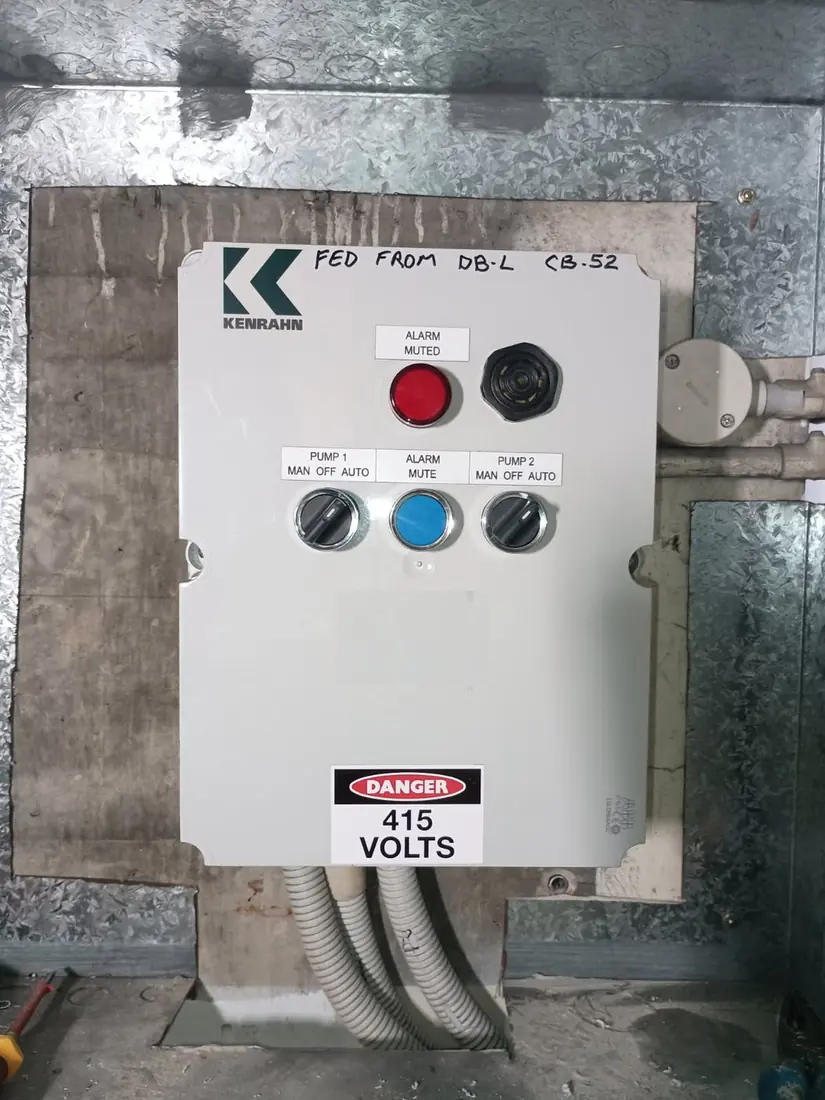
Six causes account for nearly every alarm callout we attend. Here's what's usually behind the noise.
The most common cause we find. Fat, wipes or rag coat the float, or it's hung up on cabling or the pit wall — so the pump never gets the signal to start and the level keeps rising until the alarm float trips.
A tripped breaker or safety switch, a failed power point, or a fault in the control panel. The pump is fine — it just isn't being fed. This is the one cause you can sometimes fix yourself with a single breaker reset.
Wet wipes, rags or a foreign object wrapped around the impeller stop the pump dead, or trip its overload. The motor hums or does nothing while the pit fills. The pump needs to be lifted and cleared — don't keep resetting it.
Worn seals let moisture into the windings until the motor shorts or trips out. An older pump that's been short-cycling or running hot for months often fails this way — the alarm is the first most owners hear of it.
A jammed valve lets everything the pump just pushed out fall straight back into the pit. The pump runs and runs but the level barely drops — eventually it can't keep up and the alarm fires.
Heavy rain finding its way into a sewer pit, or groundwater seeping through cracked pit walls. The pump is healthy but overwhelmed. Common after big storms — and a sign the pit needs attention, not the pump.
Whatever the cause, the diagnostic process is the same: megger and amp testing, the float run through a full cycle, the valve and discharge checked. Most faults are fixed in a single visit — see our pump repairs page for how that works.
Alarm sounding right now? Tell us what the panel's showing.
📞 0415 210 267An honest framework — the same one we use on the phone when you call after hours.
Not sure which column you're in? Call anyway — it costs nothing to ask, and we'd rather talk you out of a night callout you don't need than have you flooded by morning. Our emergency pump services page covers how after-hours callouts work.
When the alarm's going and the pit is filling, you want to know exactly who's turning up. Here's what backs the van.
Sewer Pump Services operates under a current NSW plumbing contractor licence — licensed plumbing and drainage work, on record.
Plumbing and drainage work is carried out to the AS/NZS 3500 standard family — the benchmark for compliant work across Sydney.
Issued by NSW Fair Trading under the disconnect/reconnect framework (UEERL0004). We connect the pump and alarm, set up the control panel and fit the overload protection ourselves; your electrician runs the supply.
Statement of Attainment from Pinnacle Safety and Training (RTO 40496). Deep pits and confined spaces are part of the trade — most residential pits never need it, but when one does, we're set up for it.
Public liability and workers compensation cover in place across all work, with certificates of currency available on request.
A plumbing trade since 1985, pumps-only since 2010. You deal with the same operators from first call through to commissioning.
Straight answers about sewer pump alarms.
One thing: the water level in the pit has risen higher than it ever should. That means the pump either isn't running — no power, stuck float, failed motor — or it's running but not moving water, because the impeller is jammed, the non-return valve has failed, or the discharge is blocked. The alarm doesn't tell you which; that's what the diagnostic visit is for.
You can silence the buzzer if the panel has a mute button — but the alarm condition is still there, and the pit is still too full. If you mute it and keep using water as normal, the next warning you get is sewage at the lowest drain in the house. Silence it for your sanity, cut water use, and get it looked at promptly.
On most panels, yes — if the pump catches up and the level falls, the alarm clears. But an alarm that fired has already told you something: the pit filled faster than the pump could empty it. Once is worth watching; repeatedly is a fault that will only get worse. If it's becoming a pattern, see our pump repairs page.
Keep it to an absolute minimum. Everything that goes down a drain ends up in the pit, and the pit is already at its alarm level. Essential toilet flushes only — no showers, no washing machine, no dishwasher — until the pump is running again.
It depends what's behind it. A dual-pump system where one pump is still keeping up can usually wait for the morning. A single-pump system that's down, a rising pit, or sewage backing up indoors can't. Call us either way — we answer 24/7 and we'll tell you honestly whether it needs a night callout or a booked visit. See our emergency pump services page for how after-hours callouts work.
Almost every alarm callout we attend traces back to a pit that hadn't been serviced. A fouled float, fat buildup, a tired non-return valve and a motor with falling insulation resistance all show up on a routine service visit — before they fail the pump at 11pm. See our pump servicing & maintenance page.
An alarm that fired has already given you your warning. Tell us what it's doing — we'll tell you honestly whether it's tonight's problem or tomorrow's booking.