
Insulation resistance test
Megger test on the motor windings to catch insulation breakdown before the pump fails. We log the reading every visit so we can spot the trend, not just one-off pass or fail.
Specialist sewer, stormwater and grease trap pump servicing across Sydney. Megger testing, amp testing, full clean, offsite waste disposal, written report — every visit. Per-visit pricing. No subscriptions, no auto-renewals.
Pumps tend to fail at the worst possible time. 2am. Long weekends. The day before guests arrive. By the time the alarm goes off, the float has usually failed or the motor is already drawing too much current — and what should have been a service has just become an emergency callout.
Regular maintenance is what stops that happening. We service sewer, stormwater and grease trap pumps across Sydney homes, strata buildings and food businesses. Per-visit pricing. No subscriptions, no auto-renewals. You book us when the service is due, or we notify you when it's coming up and wait until you're ready.
We test the pump electrically, test the float mechanically, pump the pit out, clean it down, remove the waste offsite — all in a single visit. You don't need to be home if we have access to the pit, and a written report comes through afterwards either way.
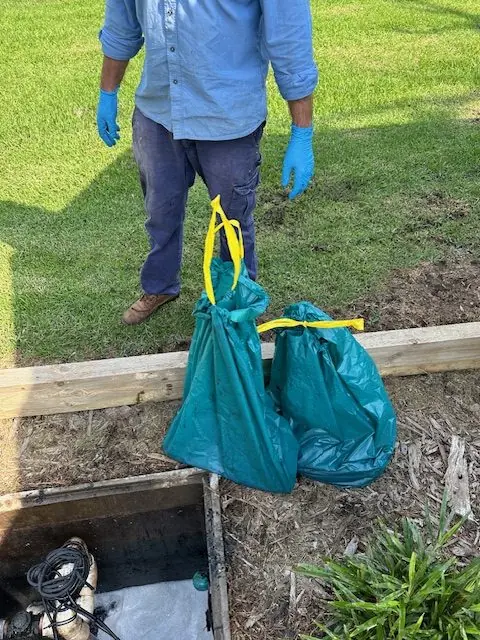
This is what hands-on pump servicing looks like across Sydney. Pit lid lifted, root mass cleared by hand, pit walls flushed, pump tested electrically and mechanically, waste bagged for offsite disposal, and a written report sent through afterwards with the test readings.
A proper service is more than a clean. We test every visit — megger reading, amp draw — and record what we find, so the readings build a history and a pump heading for failure shows up months before it actually fails. A clean alone resets the pit; the testing is what tells you where the pump is headed.
Get your pump serviced by people who service pumps every day. Talk to the specialists.
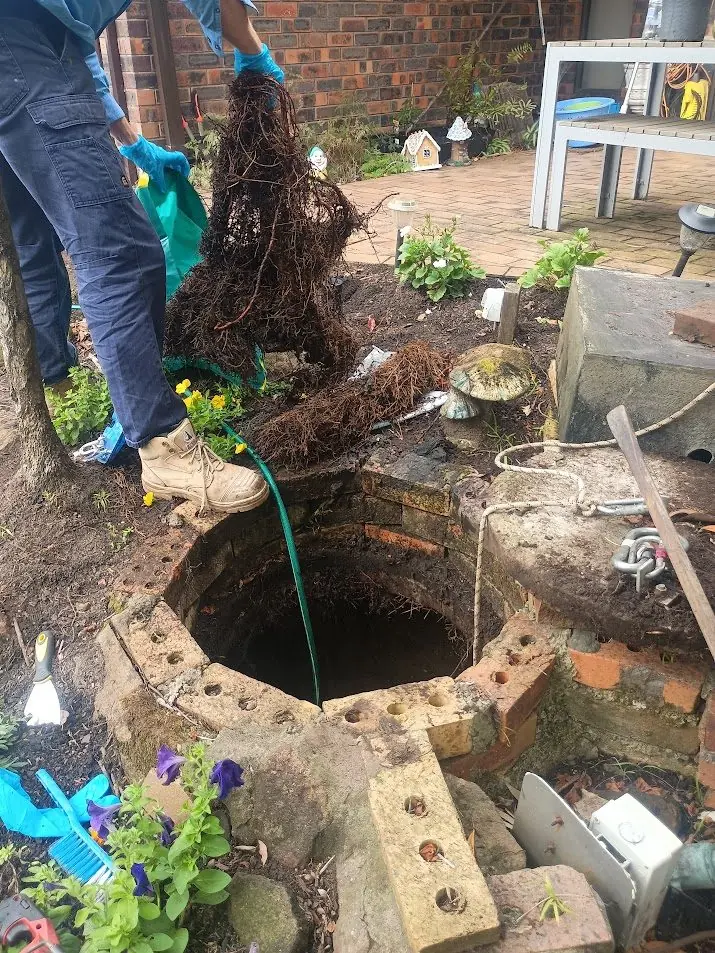
Root mass removed from a Yowie Bay pump pit during service — pit cleared, system checked, written report sent through.
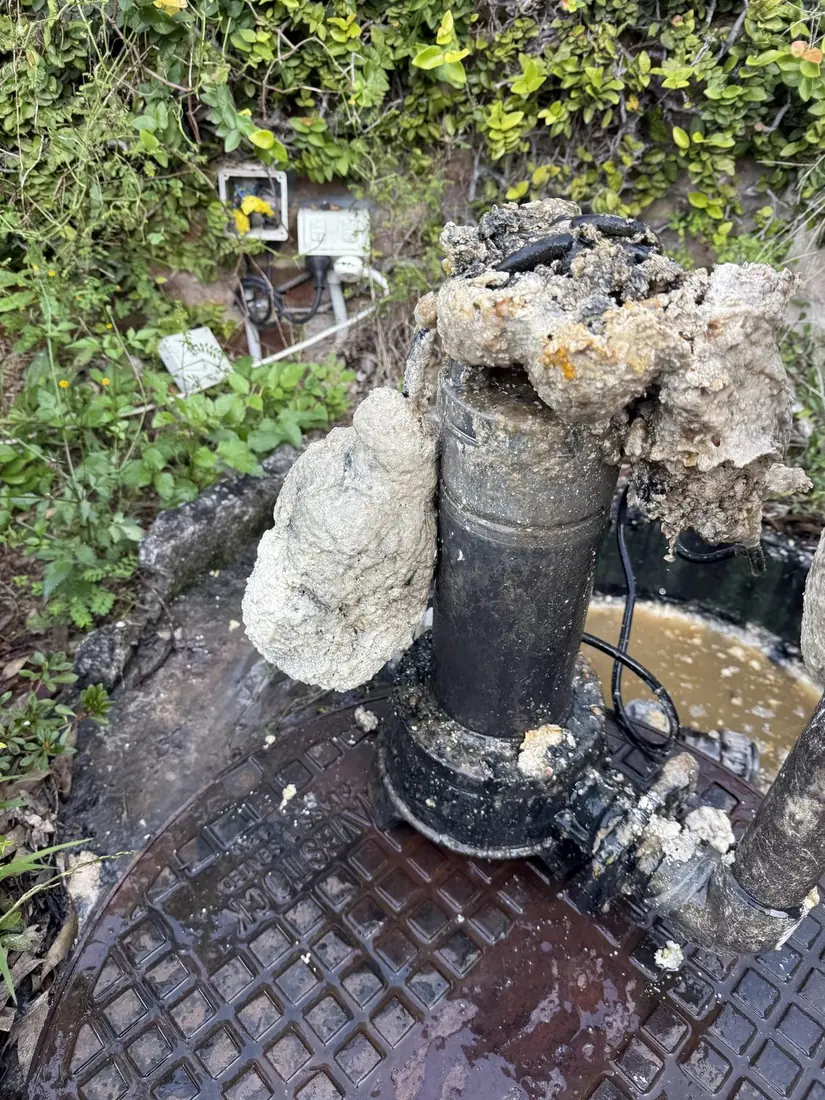
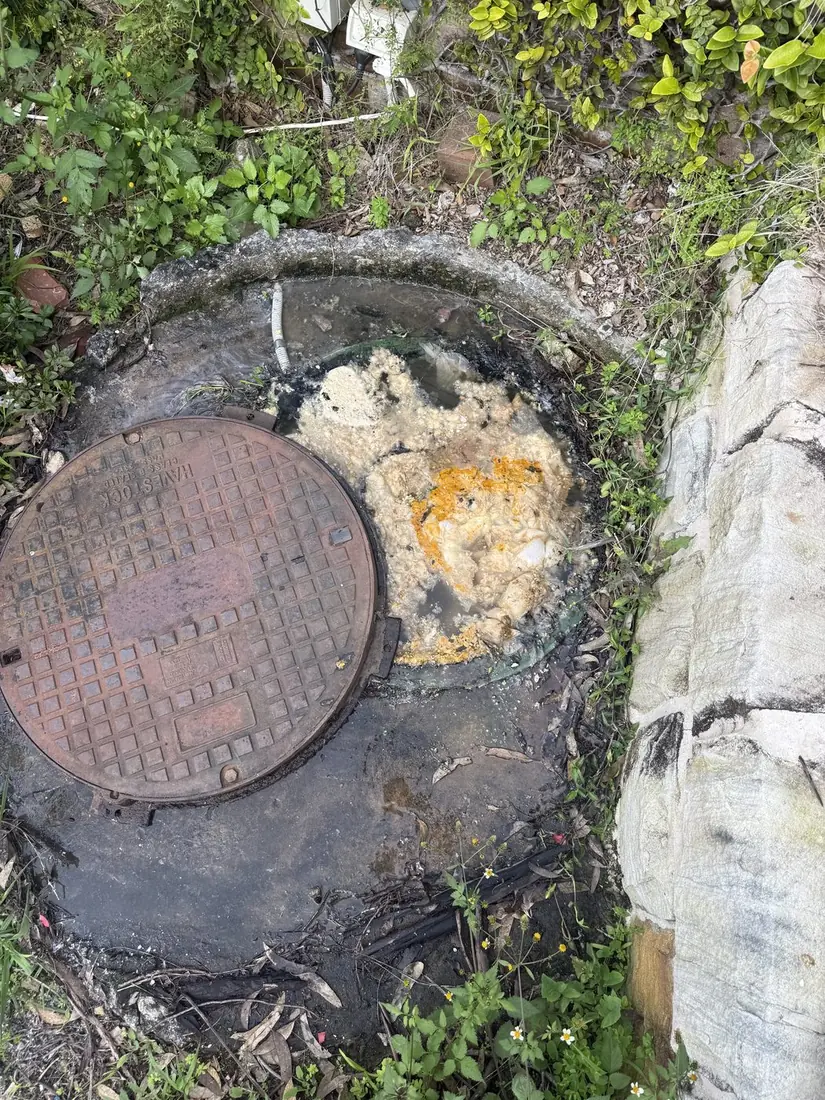
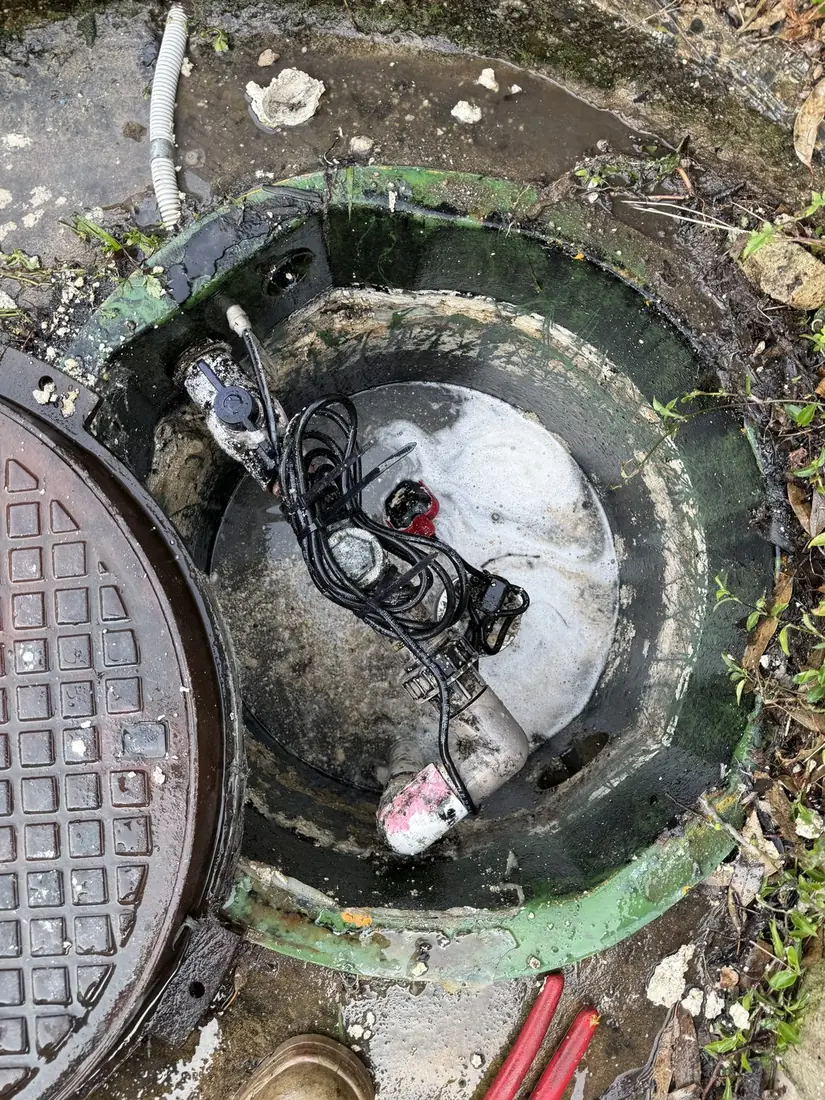
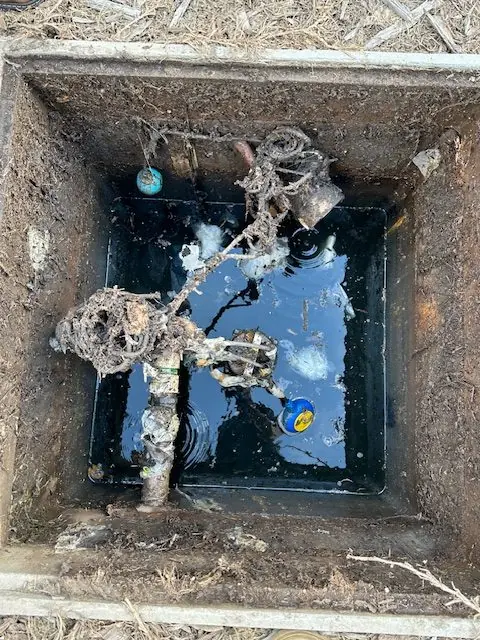
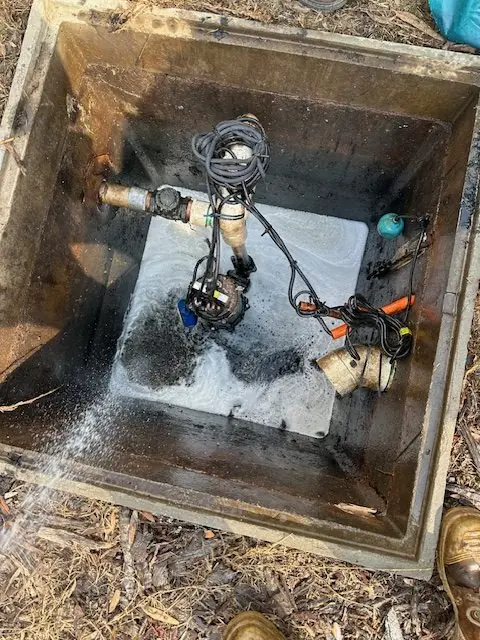
Most pump failures aren't sudden. Fat builds up on the float itself, layer by layer, year after year, until the float is too coated and weighed down to rise as the pit fills. Once the float can't float, the pump can't tell the pit it's full — and the next big inflow goes out the nearest weak point. Three photos from one job.
Most grease traps don't have pumps at all. Where the kitchen sits at or above the level of the sewer main, gravity does the work — waste flows through the trap and out to the street on its own.
Where it gets interesting is below-street-level kitchens, basement food courts and hotel kitchens dug into the slab. The grease trap can't drain to the sewer by gravity, so the trap discharges into a separate pump pit downstream. Inside that pit sits a submersible pump that lifts the treated waste — covered in kitchen FOG (fats, oils and grease) — up to the main sewer line at street level. Most often a dual-pump setup, given the wear these systems take and the consequences of a failed pump going unnoticed.
Standard trap-system pumps are usually vortex pumps — they move liquid with minimal solids efficiently, without needing to macerate. Where the same pit also takes sanitary waste from kitchen and amenity fixtures, there's more reason to lead with a cutter or grinder pump instead, which shreds the stringy material that would otherwise jam a vortex pump.
These pumps are what we service. The pumps come out, rising mains get checked, the pit gets cleaned, both pumps get tested electrically and mechanically. Single visit, full system, written report after.
This is separate work from the trap pump-out itself. Sydney Water sets that frequency on your trade-waste permit — typically every 4, 8, 13 or 26 weeks — and that work is done by an authorised Wastesafe transporter with a tanker. We service the pump downstream of the trap, the one lifting waste to street level. Most pumps in this position benefit from a service every 6 to 12 months, if not sooner — depending on kitchen volume.
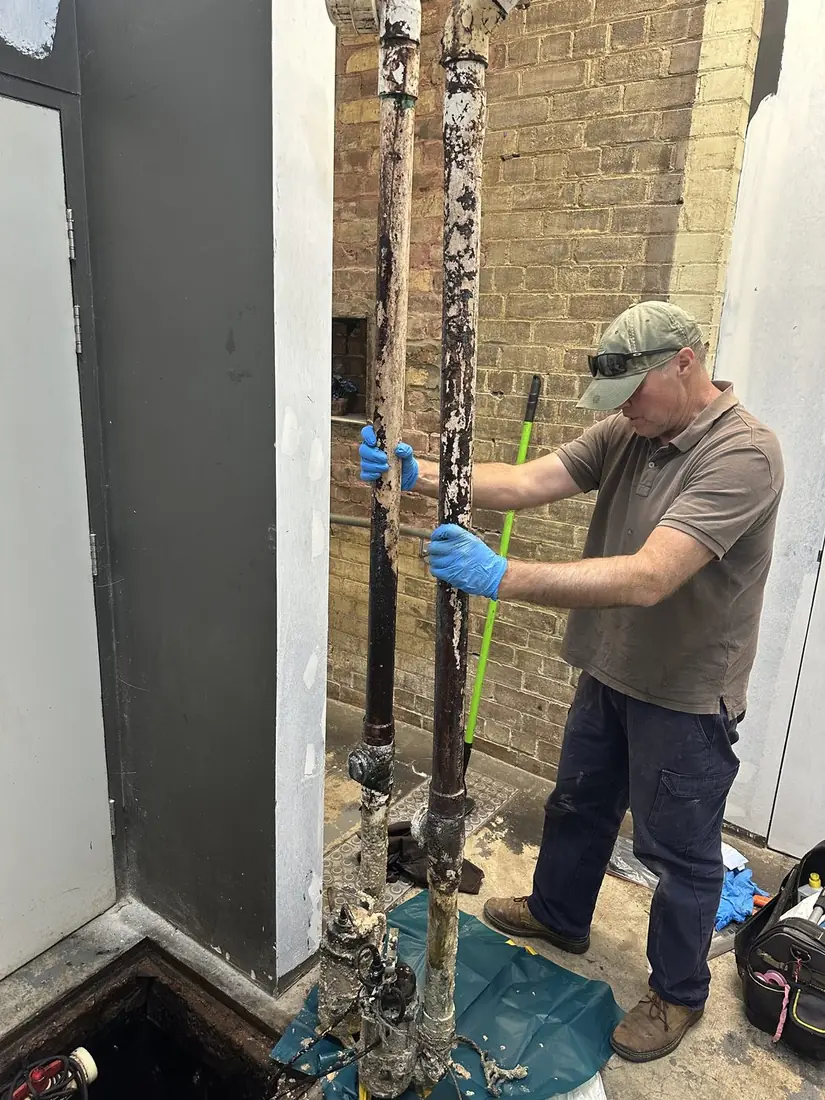
Stuart mid-service on a Sydney grease trap pump pit — dual pumps lifted, rising mains caked in hardened fat from a busy kitchen, floats coated and seized. Ready for clean-out and testing.
A clean is half a service. The other half is testing — and the report that tells you what the readings mean.
Megger test on the motor windings to catch insulation breakdown before the pump fails. We log the reading every visit so we can spot the trend, not just one-off pass or fail.
Running amps measured at the control panel and compared to the pump's nameplate rating. A reading above the nameplate points to bearing wear, impeller damage or partial blockage. The number tells us what's coming.
Each float manually tripped at its set point. Cable, mounting position and cycle all checked. A stuck or fouled float is the most common reason an otherwise healthy pump stops running.
Pit pumped out, pump lifted if access requires it, walls and inlet/outlet flushed back to surface. Fat and debris build-up is what jams floats and holds odour — a proper clean resets the system.
Pit contents removed offsite for proper disposal. Nothing washed into the stormwater system, nothing left for you to deal with.
A written service report is included with your invoice — covering test readings, findings and recommendations from the visit.
A megger test on the motor windings catches insulation breakdown before the pump fails. The reading goes on the report every visit so we can track the trend — a healthy pump's number stays steady, a failing pump's drops over time. By the time the alarm goes off, the megger reading has usually been telling us trouble was coming for months.
Amp draw at the control panel does the same job for bearing wear and impeller damage. A reading above the pump's nameplate rating means something's pulling the motor harder than it should. The number tells us what's coming.
Testing every visit and recording the readings is what separates a service from a clean. A reading, a record, an early warning — that's the difference between catching a pump on the way down and meeting it after it's failed. Specialist work means specialist tools and a record of what they showed.
On a service we also flag if your control panel is missing overload protection — the switch that trips the pump before a stuck impeller pulls the motor into thermal failure. A rag, a wipe or a piece of root caught in the propeller is enough to send the amp draw spiking, and a pump without overload protection just keeps pulling current until the windings burn out. Cheaper to retrofit than to replace a burnt-out pump.
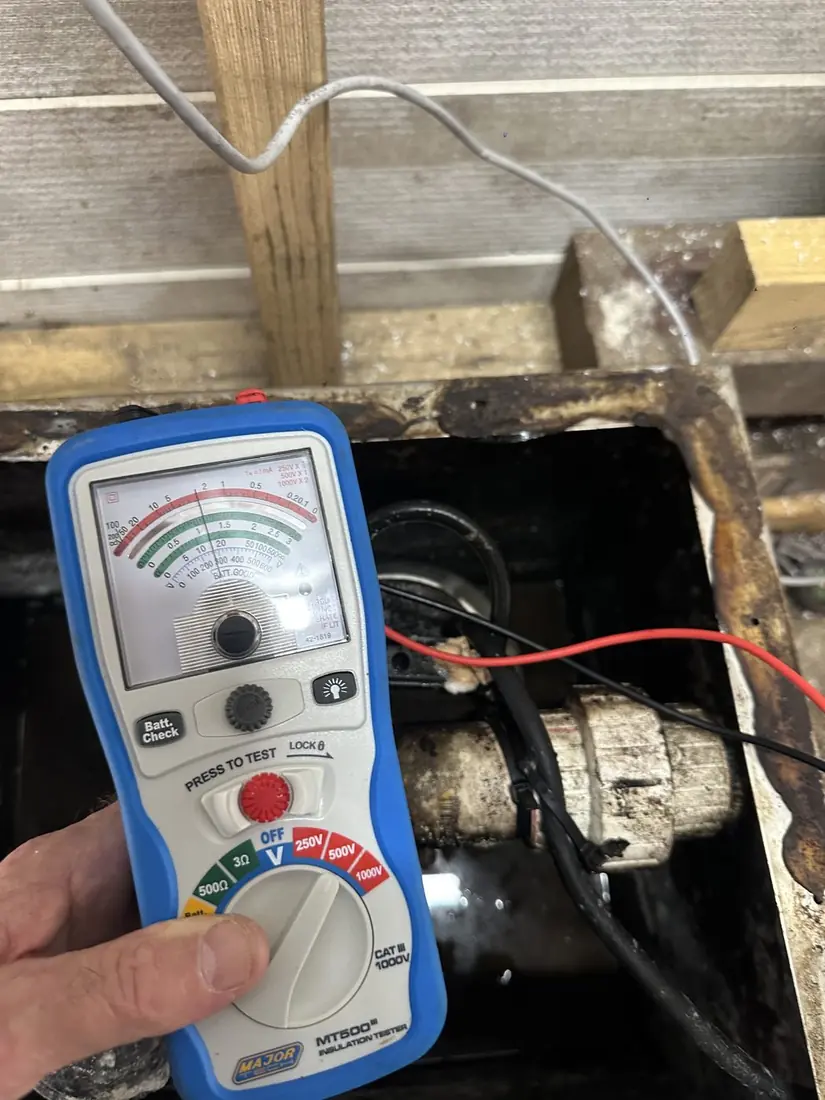
Insulation resistance test in progress on a pump service. Reading logged on the report — we track the trend, not just one-off pass or fail.
Pumps rarely fail without warning. The warning just tends to be subtle until it isn't.
Even if it stopped, it fired for a reason. Don't wait for the next one.
Fixtures upstream are slow or gurgling. The pump can't keep up with flow, isn't pumping at all, or the float is activating late.
Bearing noise points to internal wear.
No noise when the pit is filling points to the pump not activating — float switch or motor side.
Run, stop, run, stop is normal. Continuous running or rapid short cycles point to float trouble or pit volume loss.
A sealed system shouldn't smell. If it does, the lid seal, vent or pit contents need attention.
A service catches what symptoms can't — early shifts in megger and amp readings, fat or debris starting to coat the float, build-up in the pit. Past the interval, those signals haven't been read for too long.
A typical service run on a Cronulla site. The pit had fouled with debris, the float was working harder than it should, and the pump was running long cycles. Clean, test, sign off — back to working order in a single visit.
We recommend annual servicing for sewer pumps, 6-monthly for stormwater, and every 6 to 12 months for grease trap pumps — unless advised otherwise. Different jobs, different content, different service rhythms.
Sewer pits collect everything that goes down the drain. Fat, hair, debris, organic material. A year is enough time for buildup to start affecting pit volume and float operation, but short enough to catch it before the pump itself starts working harder than it should.
A year of sewer service catches:
Stormwater pits collect leaf litter, silt and grit. We recommend 6-monthly for strata buildings and high-consequence sites — places where a flooded basement or carpark is the cost of failure. Domestic systems on lower-risk sites can usually stretch to yearly. Either way, the visit catches debris before it impacts the pump.
A 6-month stormwater service catches:
Grease trap pump pits load up with hardened fat from cooking oil, dairy and food waste — kitchen FOG (fats, oils and grease). We service the pump every 6 to 12 months — busier kitchens need it more often. This is separate from the Sydney Water Wastesafe pump-out of the grease trap itself, which Sydney Water schedules on your permit (typically every 4, 8, 13 or 26 weeks) and is done by an authorised Wastesafe transporter.
A grease trap pump service catches:
Per-visit pricing. No subscriptions, no auto-renewals. Don't be the next emergency callout we get for a problem a service would have caught.
Four steps. From phone call to written report, no chasing, no surprises.
Call or use the contact form. We confirm a date and time that works for both of us.
On arrival we open the pit, identify the system, and confirm the scope of work. You don't need to be home if we have access to the pit.
Megger and amp testing, float testing, pit pumped out and cleaned, waste removed offsite. Anything worth flagging is documented as we go.
Written report sent through after the visit. Test readings, observations, recommendations, and your next service date.
Specialist work means licensed work, documented work, and work that meets the standards Sydney is built to.
Sewer Pump Services operates under a current NSW plumbing contractor licence — licensed plumbing and drainage work, on record.
Plumbing and drainage work is carried out to the AS/NZS 3500 standard family — the benchmark for compliant work across Sydney.
Issued by NSW Fair Trading under the disconnect/reconnect framework (UEERL0004). We connect the pump and alarm, set up the control panel and fit the overload protection ourselves; your electrician runs the supply.
Statement of Attainment from Pinnacle Safety and Training (RTO 40496). Deep pits and confined spaces are part of the trade — most residential pits never need it, but when one does, we're set up for it.
Public liability and workers compensation cover in place across all work, with certificates of currency available on request.
A plumbing trade since 1985, pumps-only since 2010. You deal with the same operators from first call through to commissioning.
Straight answers about pump servicing and maintenance.
Annually for most systems. A year is enough time for fat, hair and debris to start affecting float operation, and short enough to catch motor issues in the megger and amp readings before they become failures. Some pits build up fat faster — heavy household kitchen use, no inline grease management, older pumps — and benefit from a 6-monthly rhythm. We'll let you know on the report if yours is one of them.
Six-monthly for strata buildings and high-consequence sites where a flood is the cost of failure. Domestic systems on lower-risk sites can usually stretch to yearly. The visit catches debris before it impacts the pump either way.
Every 6 to 12 months, depending on kitchen volume. Busier kitchens push hardened FOG (fats, oils and grease) into the rising mains faster, so a 6-month rhythm suits them better. This is separate from the Sydney Water Wastesafe pump-out of the trap itself, which Sydney Water schedules on your trade-waste permit.
Insulation resistance (megger) test on the motor, amp draw test at the control panel, float switch test, pit pump-out and clean, offsite waste disposal, and a written report with findings and recommendations.
A clean service without anything worth flagging usually takes around an hour. If we find issues that need investigation — heavy fat buildup, float problems, electrical faults, anything that warrants closer testing — the visit runs longer. We don't rush past anything that's worth a closer look.
You'll see it on the report. We quote the repair separately so you can decide. If it's urgent, we tell you. If it can wait, we tell you that too.
Yes. We service and repair Davey, Liberty, DAB, Grundfos, Mono, Flygt, Bianco, Zenit and most other major brands. We keep stock on the most common residential pumps so most repairs and replacements are completed in a single visit. If we don't have your pump on hand, we'll tell you up front before you commit.
A beeping alarm means the pit is filling faster than the pump is emptying it. Either the pump has stopped (failed motor, tripped breaker, or jammed float), the pump is running but not pumping (impeller wear, blocked discharge, or seized non-return valve), or there's a major inflow event the pump can't keep up with. Don't ignore it — call us and we'll diagnose same day in most cases.
Most pump servicing is licensed plumbing work in NSW. The pit pump-out and waste handling are regulated, and the electrical disconnection and reconnection of the pump itself is regulated under the NSW Restricted Electrical Licence framework (Disconnect/Reconnect, Motors). Beyond compliance, the megger and amp testing that catches problems early needs specialist gear and on-the-tools experience to interpret the readings. A pit lid lift and visual inspection you can do yourself; the actual service shouldn't be DIY unless you hold the licence and equipment to do it safely and legally.
The pump itself is almost always common property — the responsibility of the owners corporation, not individual lot owners. Pump pits, rising mains, alarm panels and electrical switchgear are also common property in most cases. Strata managers or owners corporations book and pay for pump servicing, and we issue reports formatted for committee minutes and AGMs.
Call us as soon as it happens. We run emergency callouts for failures outside scheduled work — same-day in most cases, after-hours when it can't wait. If the alarm is going off, the pit is overflowing, or there's a smell or wet area near the pit, that's emergency, not service.
Based in the Sutherland Shire. Servicing all of greater Sydney.
Cronulla · Caringbah · Sutherland · Miranda · Bundeena · Burraneer · Lilli Pilli · Yowie Bay · Sylvania Waters · Como · Woolooware · Kangaroo Point
Manly · Mosman · Dee Why · Brookvale · Freshwater · Curl Curl · North Curl Curl · Collaroy · Whale Beach · Palm Beach
Cammeray · Longueville · Hunters Hill · Lane Cove · Northbridge · Chatswood
Bondi · Randwick · Coogee · Maroubra · Vaucluse
Newtown · Marrickville · Leichhardt · Ashfield
Not listed? Call us — we cover all of metropolitan Sydney for servicing and maintenance.
Send your name, number and what's going on — we'll get back to you the same business day. For active flooding or sewage backup, please call instead.
Urgent? Call 0415 210 267 — 24/7.
Annual sewer, 6-monthly stormwater. Catch problems before the alarm does.