
NSW Plumbing Licence 456767C
Sewer Pump Services operates under a current NSW plumbing contractor licence — licensed plumbing and drainage work, on record.
A pump system is only ever as good as the way it's put together. Here's a plain-English run through the parts — the pump, the floats, the control panel, the alarm — and what separates a system that runs for years from one we get called back to. Pump specialists since 1985.
Some properties sit too low to drain to the sewer or stormwater line by gravity — below the street main, down a hill, in a basement or carpark. A pump system does the lifting gravity can't.
Everything drains into a holding pit. A float switch senses the level and starts the pump; the pump lifts the water up and out through a rising main; and a non-return valve stops it draining back. A control panel runs the cycle, and a high-level alarm warns you if the water ever climbs past where it should.
Match those parts to the job and set them up properly, and the system looks after itself for years. When they're not, it's the small things that bring us back out — and the rest of this page walks through each part, then how a system should actually be put together.
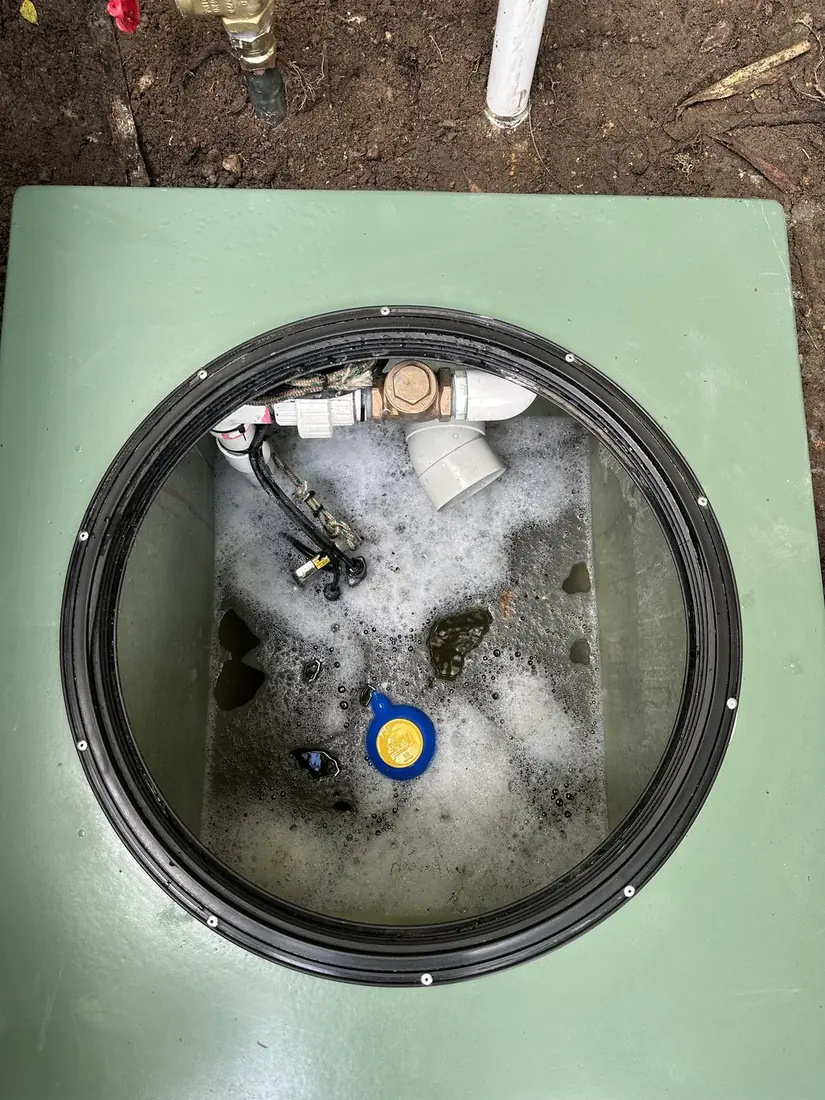
Almost every modern sewer and stormwater pump we install is submersible — it sits down in the pit, below the water. What matters is how it handles what's coming through it, and that splits along whether it's sewage or stormwater.
The default residential pump — it handles raw sewage with solids and lifts it up to the main. The starting point for most homes.
An ejector with a built-in grinder that pulverises solids to a fine slurry before pumping. More reliable through the realities of a modern sewer system — and our usual call.
The lighter-duty alternative — it slices solids rather than pulverising them. Fine where the waste stream is predictable.
The impeller sits recessed up in the housing and drives the water by spinning up a vortex, so leaves, grit and stringy debris pass through underneath without ever catching on the blades. Less efficient than a direct impeller, but far harder to clog — the usual call where stormwater carries muck.
Built to shift clear or lightly dirty water fast — ground water, surface run-off, a flooded pit or basement. High flow, low solids: it moves water rather than waste.
For brands, Davey is our default across the board — the most reliable for the money, sewer or stormwater. We step up to DAB, Bianco or Liberty as the head and duty call for it, Liberty in particular for homes with children, for its resistance to foreign objects. On stormwater, Davey still covers most installs; where someone wants something more heavy-duty, Grundfos is an excellent option, though it sits at the pricier end. We match the pump to the pit and the job, not one brand to everything; the full selection logic lives on our sewer pump installation and stormwater pump installation pages.
When you buy a pump it comes as one of two types — automatic or manual — and the difference comes down to how the float that switches it is set up.
An automatic pump comes with its float switch built on. It's what we recommend for a single-pump system — it bypasses the need for a control panel and can be wired straight to an isolation switch with overload protection. Simple, direct, and fewer things to go wrong.
A manual pump has no float of its own — it's switched externally through a control panel. Every dual-pump system runs on manual pumps: the panel alternates the two pumps and takes its cues from separate floats set in the pit. The float still does the sensing — it's just wired back to the panel rather than built onto the pump.
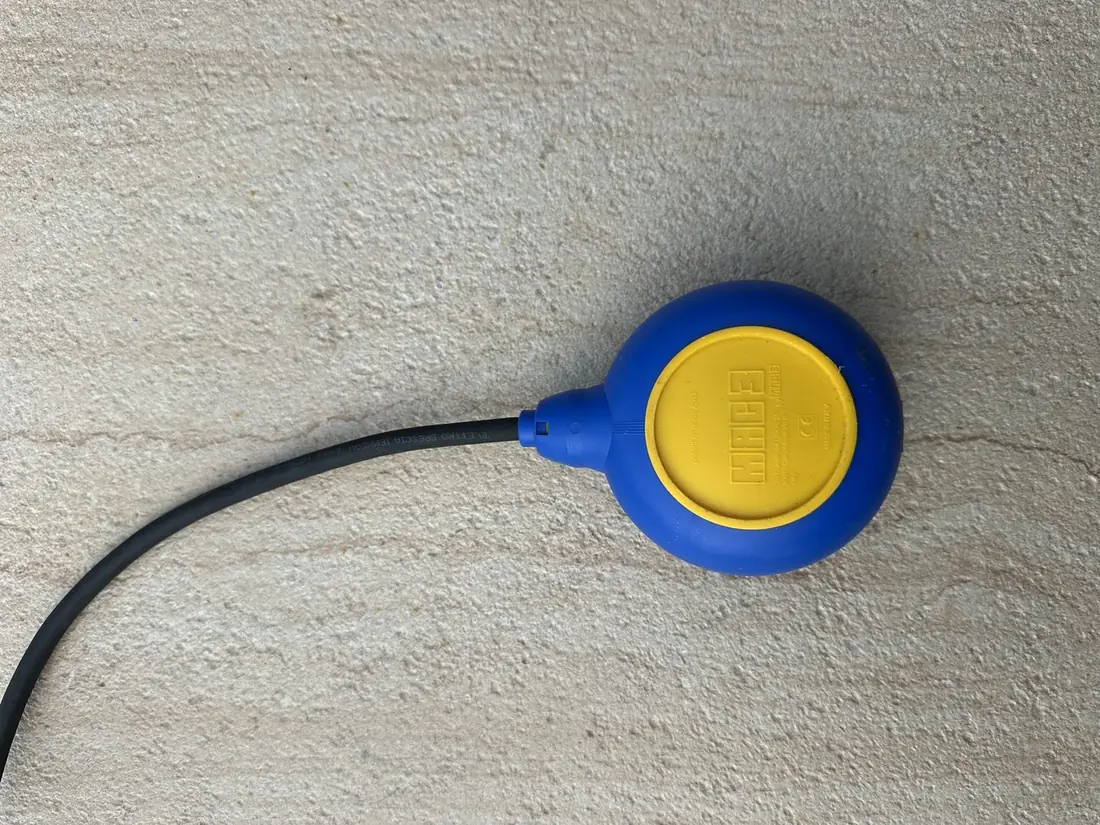
The float is the level sensor that tells the pump when to run. It hangs in the pit and swings up as the water rises; at a set height it switches the pump on, and off again as the level falls. Simple — and that's their strength — but a float only works if it can move freely and its cable stays sound.
A pit can run on a single float or several, each with its own job. The simplest setup uses one float to start and stop the pump. Add a second, set higher, and it becomes the high-level alarm — triggering if the water ever climbs past where it should. A dual-pump pit uses more again, staging the two pumps and the alarm off separate floats.
Our usual pick is the Mac3 float, made in Italy. The cable matters most: a heavy rubber-sheathed immersion lead — 3-core, 1mm² conductors — that stays flexible over the years and resists cracking, which is exactly how cheaper floats fail (the cable goes hard, splits, and water gets into the switch). The body is a sealed IP68 unit, weighted and smooth so it swings cleanly in both sewage and stormwater pits. Not the cheapest, but the one we trust to still be switching in a decade.
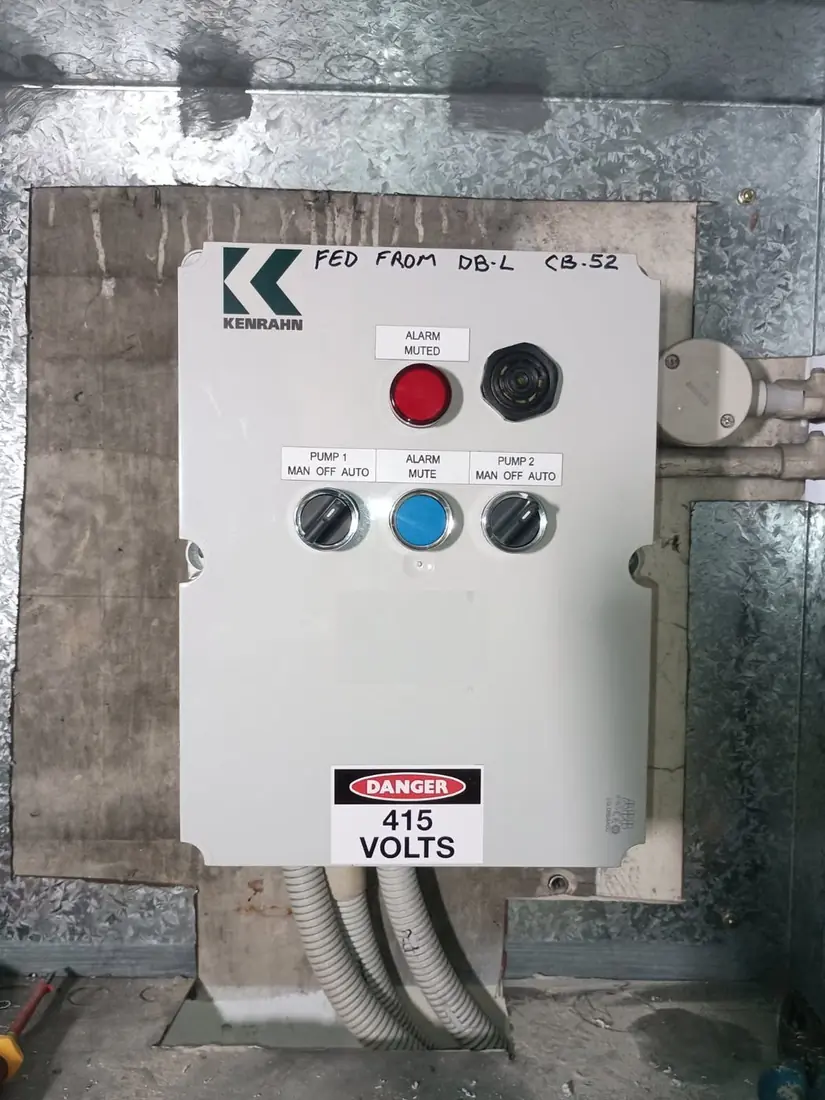
The control panel is the brain. It takes the signal from the floats and runs the pump automatically, drives the high-level alarm, gives you the MAN-OFF-AUTO control, and houses the overload protection that guards the motor. On a dual-pump system it's also what alternates the two pumps so they share the work.
Our usual pick is Kenrahn — Australian-made panels we've come to trust for the work they go into. The panel here is a dual-pump system: a separate MAN-OFF-AUTO selector for Pump 1 and Pump 2, an alarm light and mute, and a clearly marked supply.
In our view, a simpler mechanical, relay-based panel is the right call for most work — and that includes dual-pump and alternating systems. There's less to go wrong, it's easier to fault-find and repair in the field, and it shrugs off the dirty power and surges that knock electronic boards over. Electronic controllers earn their place on large infrastructure that genuinely needs remote monitoring or telemetry — but for a home or a typical strata pit, we'd rather fit something basic and reliable than complex and fragile. It's a judgement we make per site, not a hard rule.
Two parts you never think about until the day they earn their keep.
Watches the current the pump draws. If something jams it — a rag in the impeller, a stuck float running it dry — the overload trips the pump off before the motor windings overheat and burn out. The difference between a callout to clear a jam and a bill for a whole new pump. We fit it as standard on every new system we install.
An independent float set above the pump's normal working range. If the water climbs past where it should, it sounds and lights up — early warning while there's still room in the pit and time to call, not after it's over the top. On strata sites it can tie back to a building management system.
For most homes, one properly sized pump is all you need. A single-pump system is simpler, cheaper to run and easy to service, and a good pump in a well-set-up pit will run reliably for years.
A dual-pump system earns its place where downtime isn't an option — strata buildings, blocks of units, commercial sites, basements and carparks, anywhere a failure floods more than one property. Two pumps share the pit and alternate, so the work and the wear are split evenly rather than one pump carrying everything. If one drops out, the other keeps the site running until we're there. It's not a static "main and backup" sitting idle — both pumps work, and either can cover the site.
Where the site allows it, we'll steer you toward a single automatic pump. With its float built straight on, it does away with the control panel altogether — and a panel, with its wiring and its alternating sequence to run, is one more thing that can go wrong. The fewer parts in a system, the fewer ways it can let you down. Dual pumps are the right call wherever a stoppage isn't an option — but more pumps and more parts isn't automatically the better system.
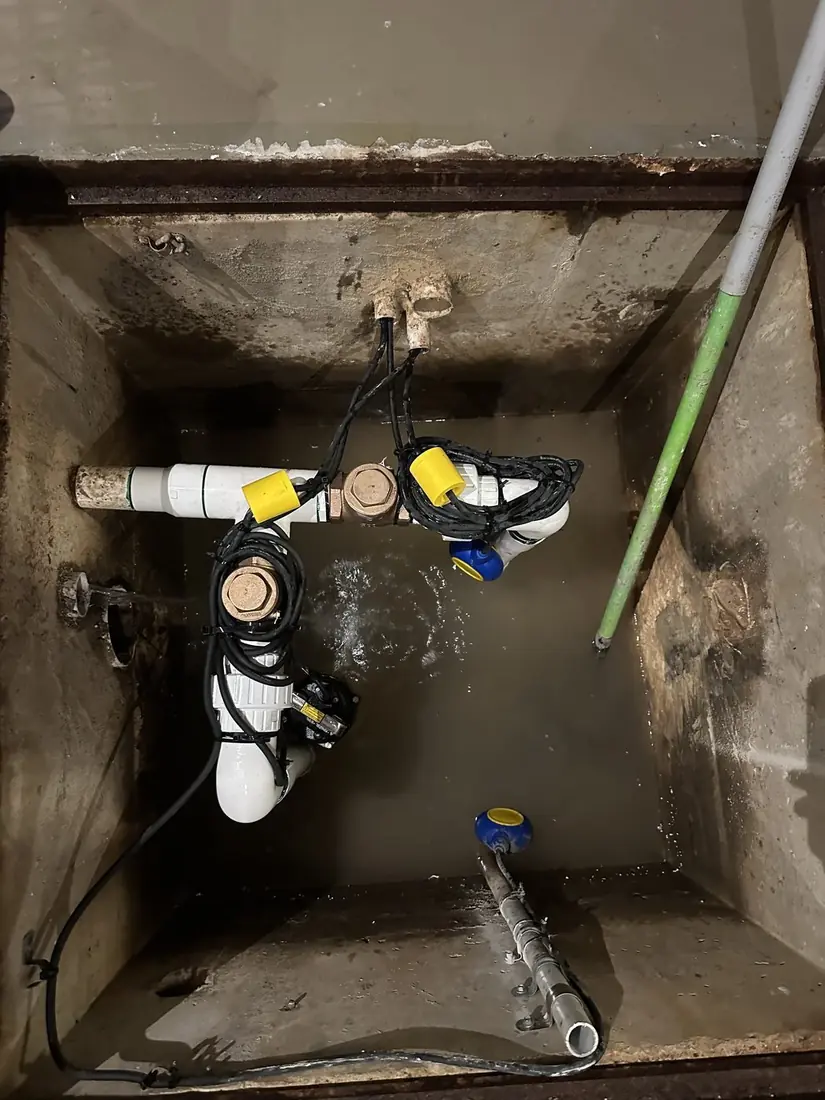
The parts can all be good and the job still fails early if the pump's the wrong size or the layout's wrong. A few things we hold to on every install — and the kind of thing we get called out to fix on the ones that weren't.
A swing-type non-return valve seats on a horizontal run, where gravity swings it shut cleanly against its seat. On a vertical pipe it either hangs open — no backflow protection — or slams shut as water hammer that wears out the valve and pipework. So the valve and union go on the horizontal, where they also stay serviceable.
Start-up torque tries to twist the whole pump in the opposite direction, and it tries again on every start. A union sitting on the vertical is a no-go — that twist slowly unscrews it, the joint backing off a little more each time until it's barely connected. Locked down, with the union on the horizontal where the spin can't undo it, the joints stay tight and the discharge stays put.
Floats are set so they can't fall back onto the pump, hang up on the pipework or pit wall, or get pushed by the inlet. A float that jams is the same as no float — the pump never starts, or never stops — and a pump that never stops is exactly what the overload ends up catching.
An undersized pump can't push against the head or keep up with the inflow, so it runs flat-out and never quite catches up. A pump that never gets to rest runs hot — and a motor run hot burns out years early. We size to the duty, not to the cheapest box on the shelf.
An oversized pump empties the pit faster than it fills, so it snaps on and off — short-cycling. Each start throws heat into the motor, and with too little water around it the pump churns away like a blender with nothing in it. Either way it wears out fast. Bigger isn't better.
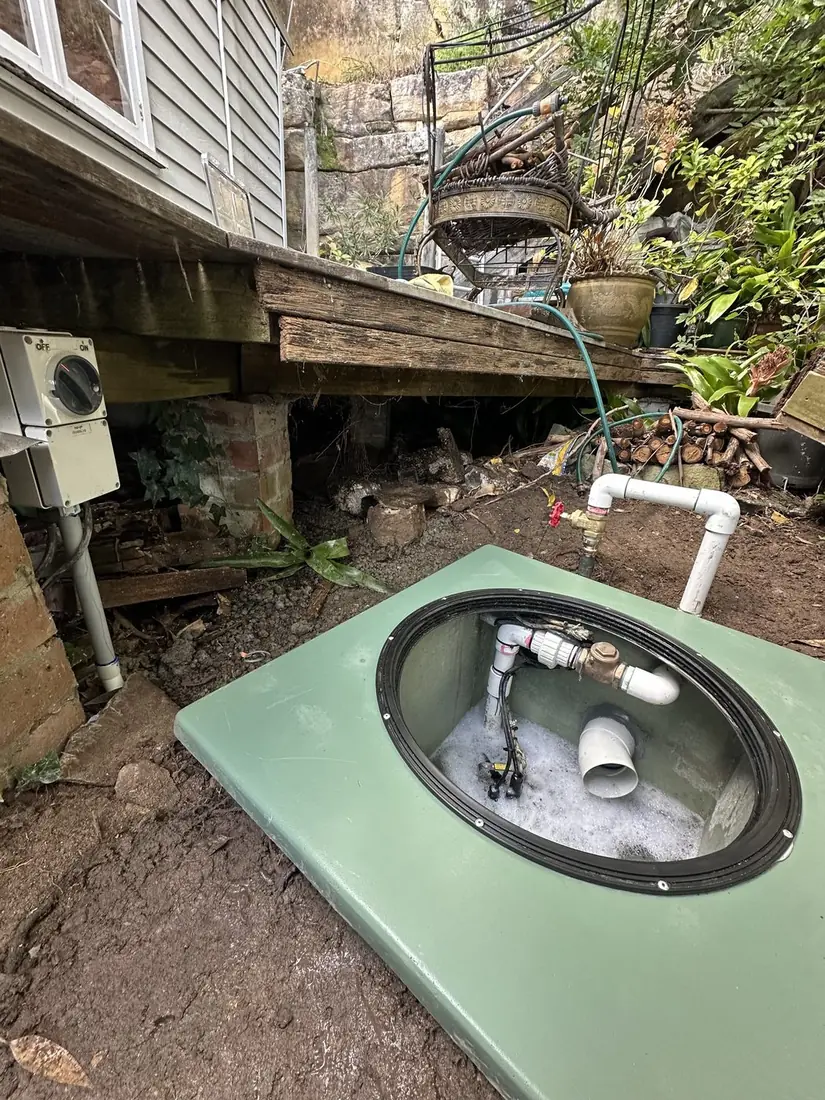
A system you can work on without breaking it open. The pit is finished with a gas-tight fibreglass lid, a man-cover lid set into it, so the pump and floats can be reached from the top — out of the ground — for every service. Where it helps, the isolation valve comes up to the surface too.
And the small thing that says the most about the rest of the install — the cabling. Done properly it's coiled and cable-tied back clear of the water and the moving floats; done lazily it's left trailing where it fouls the floats and turns the next service into a knot to untangle.
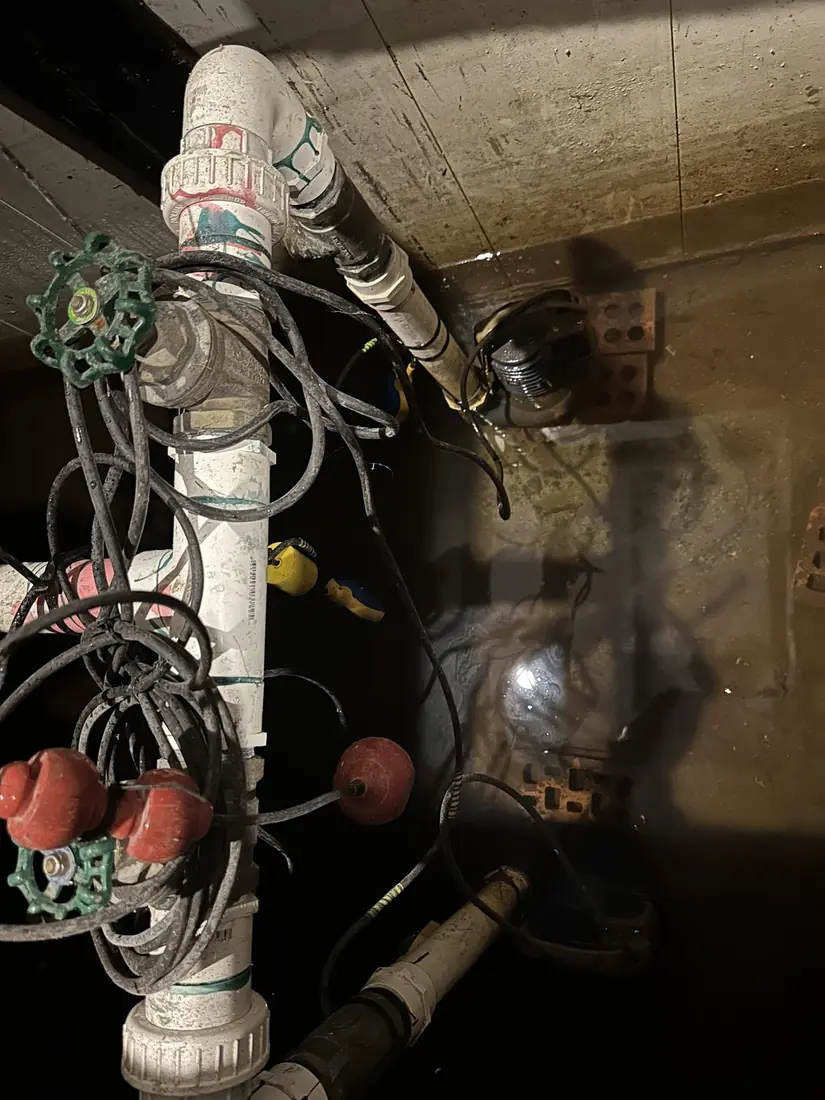
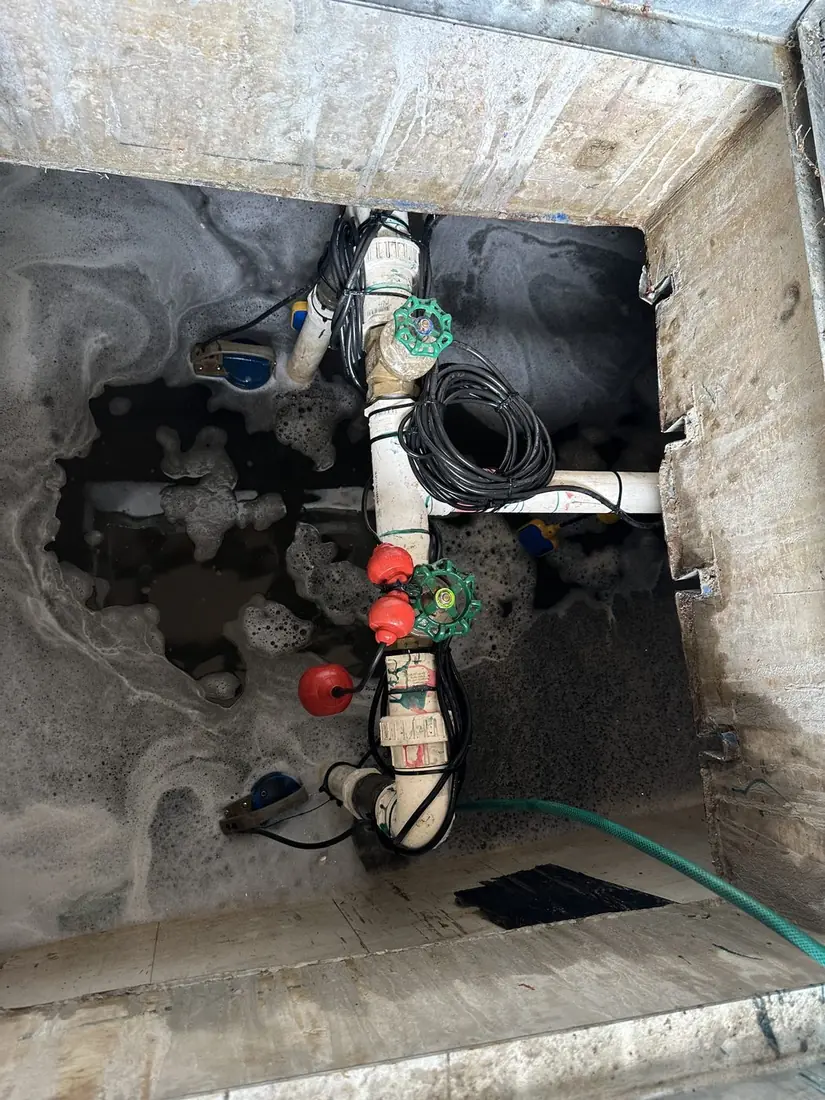
Everything on this page comes together in one job. Down in the pit, the non-return valve and union sit on the horizontal, not the vertical — so the pump stays put rather than crawling across the pit floor as it kicks and twists on every start. The union also lets the whole assembly be broken apart for a service without cutting pipe.
The inlet is turned with an elbow slab repair coupling, sending the incoming flow away from the float so the inrush doesn't knock it about or trip the pump early. The float itself is set to swing through its full range without fouling the pump or the pipework.
Above ground, the gate valve is brought up out of the pit on the discharge, so the rising main can be shut off from the surface — no confined-space entry just to isolate the pump. The pit is finished with a gas-tight fibreglass lid and man-cover, so the pump, float and valves are all reachable from the top, out of the ground. And the electrical isolation switch — IP56-rated, with its overload — is mounted well clear of the pit on the beam, safe, dry and simple to reach.
None of it is on show for a customer to admire. But it's the whole difference between a system that's a quick service and one that's a fight every time someone has to touch it.
Got a pump system that needs installing, sorting, or a second opinion?
📞 0415 210 267Knowing how a pump system works is one thing. Being licensed, certified and insured to install and connect every part of it is another — here's what backs the work.
Sewer Pump Services operates under a current NSW plumbing contractor licence — licensed plumbing and drainage work, on record.
Plumbing and drainage work is carried out to the AS/NZS 3500 standard family — the benchmark for compliant work across Sydney.
Issued by NSW Fair Trading under the disconnect/reconnect framework (UEERL0004). We connect the pump and alarm, set up the control panel and fit the overload protection ourselves; your electrician runs the supply.
Statement of Attainment from Pinnacle Safety and Training (RTO 40496). Deep pits and confined spaces are part of the trade — most residential pits never need it, but when one does, we're set up for it.
Public liability and workers compensation cover in place across all work, with certificates of currency available on request.
A plumbing trade since 1985, pumps-only since 2010. You deal with the same operators from first call through to commissioning.
Now you know how it works — here's the page for whatever you're actually trying to sort.
The questions people ask when they're trying to understand what they've got.
Waste or stormwater drains into a holding pit. A float switch senses the water level, and once it rises to a set point the float tells the pump to start. The pump lifts the water up and out through a rising main to the sewer or drainage line, and a non-return valve stops it draining back into the pit. When the level drops, the float switches the pump off again. A control panel runs the cycle, and a high-level alarm warns you if the water ever rises past where it should.
An automatic pump has its switching built in or attached — a float that starts and stops it on its own, so it cycles without anyone touching it. A manual pump only runs when something else switches it on, like a float wired back to a control panel or a hand switch. Most residential pits run automatically.
The float is the level sensor. It hangs in the pit and swings up as the water rises; at a set height it switches the pump on, and it switches off again as the level drops. They tend to fail in two ways — the cable goes hard and cracks over the years so water gets in, or the float gets fouled or hangs up on the pipework and stops moving freely. A float that can't swing is the same as no float: the pump either never starts, or never stops. It's why we care about the cable quality and where the float sits.
It's the safeguard that watches how hard the pump is working. If the pump jams — a rag wrapped in the impeller, a stuck float making it run dry, something lodged in the volute — it starts drawing more current than it should. The overload trips and shuts the pump down before the motor windings overheat and burn out. It's the difference between a service call to clear a jam and a bill for a whole new pump.
For most homes, one properly sized pump is plenty. Dual-pump systems earn their place where downtime isn't an option — strata buildings, blocks of units, commercial sites, anywhere a failure floods more than one property. The two pumps alternate to share the workload and even out the wear, and if one drops out the other carries the site until we're there. It's about resilience for the sites that can't afford to wait.
It's an independent warning, set above the pump's normal working range. If the water ever rises past where it should — because the pump has stopped, a float has failed, or the inflow has outrun the pump — the alarm sounds and lights up. The point is early warning: you find out the pump isn't keeping up while there's still time to call, not after it's come over the top of the pit.
In our view, a simpler mechanical, relay-based panel is the right call for most jobs — including dual-pump and alternating systems. There's less to go wrong, it's easier to fault-find and field-repair, and it shrugs off the dirty power and surges that knock electronic boards over. Electronic controllers earn their place on large infrastructure that genuinely needs remote monitoring or telemetry. For a home or a typical strata pit, we'd rather fit something basic and reliable than complex and fragile — but it's a judgement we make per site.
Davey is our default across the board — the most reliable for the money, on sewer and stormwater alike. We step up to DAB, Bianco or Liberty as the head and duty call for it, Liberty in particular for homes with children, for its resistance to foreign objects. On stormwater, where someone wants something more heavy-duty, Grundfos is an excellent option, though it sits at the pricier end. We match the pump to the pit and the job rather than fitting one brand to everything. The full selection logic lives on our sewer pump installation page.
A swing-type non-return (check) valve is designed to seat on a horizontal run, where gravity swings it shut cleanly against its seat and holds back the water in the rising main. Put the same valve on a vertical pipe and it either hangs open — giving you no backflow protection at all — or slams shut when the pump stops, which is the bang you hear as water hammer, and over time that damages the valve and the pipework. So we keep the valve and its union on the horizontal where they belong, and where they can be serviced.
Usually a stuck float that never tells the pump to stop, or a pump that simply can't keep up with the inflow. Either way it's running far harder than it's meant to, and left going it overheats — which is exactly what the overload is there to catch. If your pump is running non-stop right now, it's worth a call before it trips out. Our repairs and emergency callout pages cover what to do.
The principle is the same — pit, float, pump, rising main, non-return valve, alarm — but the detail differs. Stormwater systems shift surface and ground water (often from basements and carparks) and tend to run hard in bursts during rain, while sewer systems handle waste and run more steadily. We fit and service both, and size the pump and pit to what each job actually has to move.
Send your name, number and what's going on — we'll get back to you the same business day. For active flooding or sewage backup, please call instead.
Urgent? Call 0415 210 267 — 24/7.
Tell us what you've got and what it's doing. We've been setting up and sorting sewer and stormwater pump systems across Sydney since 1985 — it's the work we do day in, day out.